
6th
July 1988
Many of those living in Aberdeen and
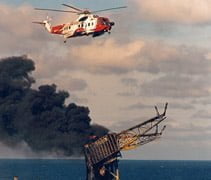
the surrounding area were woken up by the sound of helicopters flying over
their houses, flying to the largest offshore oil piping disaster that the world
has ever seen. The crew of the Piper Alpha platform consisted of 230 men. Only
63 were to make it out of the Piper that night. This article is a tribute to
those who never managed to get out due to the negligence of their employers.
On the morning of the accident, pump
A’s pressure safety valve was released for routine maintenance, as the pump’s
fortnightly overhaul was planned but had not yet been started. The open Condensate
pipe was for the time being sealed with a flat metal disc. Due to the fact the
work could not be finished until 6 pm, the metal disc remained in place. The
engineer on duty filled out a permit in which it was declared that the pump was
not to be turned on under any circumstances whatsoever.
By the time the day shift and ended
night shift began, with 62 men running the Piper Alpha, the engineer found the
on-duty custodian. The engineer neglected to inform him of the metal plate in
pump A. He went on to place the permit in the control centre before leaving.
The permit disappeared and was never found again. Another permit was issued for
the overhaul of pump A that had not yet started.
Piper Alpha had an automatic
fire-fighting system, which was driven by both diesel and electric pumps. The
electric pumps would be disabled by the coming explosions. The diesel pumps
would suck in water from the sea and would be used in the fire- fighting. However
if divers were working in the water below the platform these pumps would be set
to go on manual. Other platforms had a set-up whereby the diesel pumps were
only set to manual if the divers were working in the direct vicinity of the
pumps, so as to stop them being sucked in with the water. However, for no
apparent reason, on the Piper Alpha platform it was dictated that the pumps
needed be set on manual whenever the divers were in the water, without regard
to their location. Due to this regulation, the diesel pipes were set to manual
on the evening of July the 6th.
At around 21:45 hours, Condensate pump
B suddenly stopped working, and could not be restarted for some reason. The
power supply of the entire offshore construction depended on that pump. This
gave the manager only a few minutes to get the pump back online, or the station’s
power supply would fail completely. A search was immediately begun so the
manager could see as to whether Condensate pump A could be started. The permit
for the overhaul was found a few minutes later. However the permit stating that
under no circumstances could pump A could be started was lost.
The safety valve was in a different place
from the pump and, due to the fact that in Piper Alpha they sorted things by
location, the missing valve was placed in a different location. As a result of
this, no one noticed that the valve was missing. The gas began to flow, and it
produced a pressure that the safety valve could not withstand. This drew the
attention of several men, in addition to setting off six gas alarms including a
high level one. Tragically, it was too late – the gas ignited and exploded. The
walls in Piper Alpha were not designed to handle explosions. This then caused
the panels around module B to become dislodged, and a small Condensate pipe was
ruptured creating another fire.
By around five past ten, Piper Alpha’s
control room had been destroyed. The design of the platform had made absolutely
no allowances for the destruction of the control room. As a result of this, no
call for evacuation was made or even attempted by using the loudspeakers.
The safety procedures in Piper Alpha
specified that personnel were to make their way to the lifeboat stations. However
this was made impossible due to the fire. As a result of this, the men moved to
the fireproofed accommodation block beneath the helicopter pad. When the smoke
began to penetrate the accommodation block two men heroically donned protective
gear, in an attempt to reach the fire-fighting systems below the deck, in an
attempt to reach the diesel pumping station. These men were never seen again.
Even more tragically, the fire
itself would have burnt out had it not been fed by the nearby Tartan and Claymore
platforms hurtling gas and oil into the heart of the fire. The Claymore
platform was only shut down after the second explosion, because the manager
feared reprisals from his superiors. The Tartan platform was not shut down due
to the cost that would be involved in doing such an action; the profits were
valued above the lives of the oil workers.
At around twenty past ten the Tartan’s
gas line burst. This now had made certain the utter destruction of platform Alpha.
In the region of 20 tonnes of gas was released instantaneously and ignited a
massive fireball that engulfed the platform Alpha. This presented those left on
the platform with a brutal choice; stay on the deck and face the possibility of
dying by another explosion or hurl themselves into the freezing North Sea,
which itself was burning.
By around half-past ten, the Tharos
fire-fighting and rescue platform, began to extend its walkway 30 meters over
to the deck of Piper Alpha. However due to a design flaw in the Tharos the
walkway took around twenty minutes to get over to the Piper Alpha platform,
giving many of those still on the platform further incentive to jump into the
North Sea.
By around twenty past eleven the
pipeline connecting Piper Alpha to the Claymore platform burst, and the
disaster finally had taken its last victims. At around 24.00 hours the
generations’ and utilities’ module slipped into the sea. By 01.00 hours the
entire platform had sunk into the sea along with the charred bodies of 163 oil
workers.
The Aftermath of
the Tragedy
There was a huge amount of criticism
of Occidental Petroleum who owned the platform, and controversy as to whether
there was sufficient time for an evacuation of Piper Alpha. Questions were also
raised as to whether the explosion and the chaos that ensued afterwards was a
general consequence of the design of the platform. Most notably the absence of
blast walls meant in the circumstances there was no way of preventing such a
tragedy. In the aftermath of the incident the Offshore Industry Liaison
Committee, described as the first post-Margaret Thatcher trade union, was
created to represent the interests of workers on oil rigs.
The 167 men killed in Piper Alpha were killed
needlessly and as a direct result of the negligence of the company in question.
In the final analysis it was the company’s thirst for profit that won over the
expense of the lives of the workers. If proper safety provision had been in
place, such a disaster would have been entirely avoidable. Sadly the Piper
Alpha disaster is but one of many examples of such greed. Every year more
workers are killed at work than in wars. The memories of those killed on Piper
Alpha must be preserved as we struggle for a socialist society in which the
health and safety of workers will never be a secondary priority.