
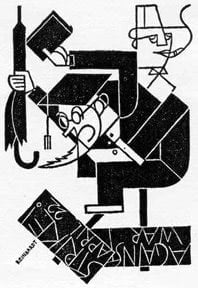
 "The politicians of reformism, these dexterous
wirepullers, artful intriguers and careerists, expert parliamentary and
ministerial manoeuvrists, are no sooner thrown out of their habitual sphere by
the course of events, no sooner placed face to face with momentous
contingencies, than they reveal themselves to be utter and complete
fools." – Leon Trotsky 1932
Recently,
The University College London Students’ Union (UCLU) voted to ban The Officer
Training Corps (OTC) from recruiting at union organized events like Freshers’
Fair. The motion, passed at the
March 5 General Meeting, said OTC was an external, non-student organization run
by the British Military, funded by the Ministry of Defence and – because
students who join could be called into active duty in case of a ‘national
emergency’ – that constituted a reserve army force, therefore giving political
and material support to the war. It went on to say that providing
stalls to OTC at Freshers’ Fair amounted to an implied endorsement of the Corps
and the Army and their activities by the Union, and directly aided officer
recruitment. Despite the noisy presence of a minority
opposed to the motion, it was passed by 89 to 59
votes. (See the Motion in full here: Troops out of UCL motion )
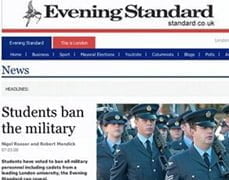
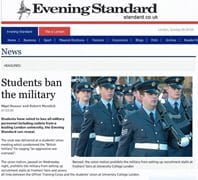
 The ban has caused quite a stir on and off
campus, making the front cover of the ‘Evening Standard’ with the banner
headline, "Students Ban Military". By
Sunday, it was in most British dailies and made the front cover of the ‘Sun’.
Under the title “Our Heroes Deserve Respect” the ‘Sun’ grossly distorted the
intent and scope of the motion saying, “Yesterday it emerged students in London
– whose idea of hardship and sacrifice is getting out of bed before lunchtime –
have voted to ban all military personnel, including cadets, from their
university campus”. Patrick Mercer, a Tory MP and former infantry commander, added his
voice to the negative chorus: "These students are deeply misguided. They
are insulting the men and women who fight for their freedom and the democratic
rights of our society." Even the shadow defence minister Gerald Howarth
said: “They should have their grants scrapped.”
 Speaking
about those in opposition to the motion, UCLU General Secretary, Samantha
Godwin, said: “they know that if replicated
elsewhere, it would become a really effective method of protesting against the
war." She explained, "Most people don’t realise that Officer Training
Corps in universities are responsible for getting 56% of all RAF pilots and 45%
of all regular army officers – basically half of the army’s officer corps
recruitment effort,” and stopping it would have a drastic impact on the ability
of the British Armed Forces to function. "The potential for this tactic in
applying pressure is huge and that is why we became so adamant about pursuing
it." said Sam, who chaired the meeting and spoke in favour of the motion
in a personal capacity.
 |
| Sam Godwin, UCLU Gen Sec |
Missing
from the headline coverage is that fact that the battle over the military ban is just
one part of an on-going struggle between the right-wing and the left-wing at
UCL, which in turn is an indicator of an even larger struggle over democracy
taking place there and in the National Union of Students (NUS) and one might
add, the political world beyond.
According to Wikipedia, the
purpose of Student Union organizations are, "…to represent students both
within the institution and externally, including on local and national issues."
It goes on to say, "Many students’
unions are highly politicized bodies, and often serve as a training ground for
aspiring politicians."
Donald MacLeod, the higher
education editor of the Guardian writes, "For decades the NUS has been a
tough nursery of political talent – if you could survive the infighting on the
executive and negotiate conference rules you could certainly make it in
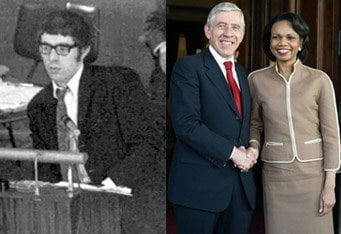
Parliament – and the long list of past presidents includes the present justice
minister Jack Straw, as well as several Labour MPs and Trevor Phillips, chairman
of the Equality and Human Rights Commission."
 Because student unions are
home to our fledgling politicians what happens there often mirrors, on a
smaller scale, the political ideas and balance of forces outside academia.
Bureaucratic tactics that lock in minority power, privilege and authority over
the majority in the larger political landscape are often mimicked.
The background to the military
ban at UCL is important. For some time there has been a series of campaigns in
universities around the country and in the federation of student unions, the
NUS pushing for what are called ‘Governance Reviews’. These reviews propose
radical changes to union structure that would see elected executives and
councils replaced with an unelected board of directors or trustees.
This quote from the website of
Students for Democracy UCL says it all: "The Governance Review would take
a union run by students for students and turn its assets over to a corporation
run by management for profit. To do this, the Governance Review would change
the legal form of the Union, from an unincorporated association with sovereign
policy making general meetings to a company limited run by a board of trustees,
accountable to no one but themselves. This would amount to a takeover of the
Union by its well paid senior management and the end of organised collective
student representation at UCL".
Sound familiar? If it does
then you can see why it is important to follow what happens in our universities
whether you are a student or not.
 At the urging of full time,
well paid managers affiliated with AMSU (the Association of Managers of
Students’ Unions) leaders such as Gemma Tumulty and Wes Streeting, (despite
some internal opposition) have been pushing for these reviews in the NUS. On
the local student union level, managers have been spurring on the sabbatical
officers (who get a paid year out on top of a good, professional sounding
addition to their CVs if they don’t end up landing a full time job there after
school) to push these policies through. In turn, the sabbatical officers have
solicited the help of a faction of New Labour, organized independents, and the
extreme right wing in the student’s union.
As in any
struggle, there are conflicting interests. For management, their interests
are mostly financial but, it is also
about job security, prestige, and power within the unions. For the right-wing students,
it is political conservatism and lack of trust in the broad population of students
to run things properly – and personal careerism. For the left-wing, who have
been generally weak and unorganized in the past, and who oppose the plan, it is
mostly a struggle to keep the last vestige of a political arena open to them.
One of the big features of the
Governance Reviews is abolishing student executive officers, leaving executive
power in the hands of full time staff. Samantha Godwin, who helped defeat the
Governance Review ‘reforms’ at UCL said she thinks the real intention behind
AMSU wanting to get rid of general meetings, "is primarily to curb the
left" and also, "to increase their job security, making them less
accountable." Thus, once governance review reforms are established, the
right have a permanent bloc of non-students to push through policies that
mostly benefit them.
But it is not only about job
security and careerism. There are real material interests at stake. Control of
the student’s union apparatus also means commercial control of student union
businesses and services like the gyms, theatres, cafes and student bars to name
a few. For example, UCLU generates over £3 million in commercial revenue as
well as £2 million in grants from the government, so the stakes are high.
Unions often have huge infrastructures with hundreds of full time, permanent
staff members and non-permanent staff. The NUS has £5 million in revenues.
The result of the campaign for
changes by Governance Reviews is that most university student unions, with
exceptions like UCL, SOAS and LSE, are now run by slim executives and elected
student councils and policy-making general meetings are mostly a thing of the
past. Referring to those university unions that have been restructured, Sam
said "It’s no longer a student union, it’s a debating society".
Despite these ‘reforms’ going
ahead in universities around the country, there was a recent surprise defeat at
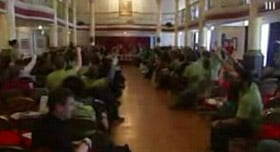
the NUS annual conference in Blackpool on April 1 where the motion proposing
‘change and modernization’ failed to
get the two thirds majority needed, missing the mark by 25 votes.
 |
| NUS Conference |
Rob Owen, a member of the NUS
executive wrote "Defeat caused the leadership to lose the plot with
denunciations of those opposed to the review and abuse directed at left wing
speakers…Policy debate for the next two days was marked by
red-baiting…"
This is the backdrop to what
happened at UCL regarding the military ban motion and then the ensuing attack
on Samantha Godwin and Sham Rajyaguru (the
proposer of the motion banning the OTC).
The contending
forces in the UCL dispute were, put crudely, the right wing which is comprised
of:
a.) Officers and student
members of the UCL Officer Training Corps
b.) Full time staffers in
union management, and
c.) The "Blairite / New
Labour students and their apathetic friends", said a pro-ban student.
On the other side, you have
the left which is generally comprised of the anti-war movement including Students for Democracy at UCL Union (SDUCL), the Stop The War Society, People and Planet,
Friends of Palestine and left wing independents.
It is openly acknowledged that
within the two leading bodies of the UCL Student Union, votes within the
Council are dominated by the left, and votes within the Executive are dominated
by the right. Sam has a position in both.
With Governance Reviews having
failed to implement their changes at UCL, General Meetings are still the top
decision making body of the union. To make the quorum (the minimum number who
must be present for valid transaction of business) 1% of the student population
must be in attendance.
Opponents of the motion
banning OTC tried every dirty trick in the book in an
effort to stop the General Meeting from taking place at all. According to one
UCL union officer, the Media and Communications officer Sean Clothier
simply refused to do his duties in promoting the meetings. After all, students
can’t show up to an event they don’t know about!
This type of sabotage has made
building for effective General Meetings difficult but, after two failed
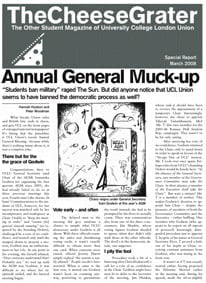
attempts, it was finally reconvened on March 5, filling the 325 seats of the Christopher Ingold Auditorium. "We made such a
big effort to advertise it that the right wing, instead of using their usual
tactic of just not showing up and calling ‘quorum’, actually mobilized for it
this time…a lot of them came but were clearly still a minority and they could
see it," said Sam.
Realizing they were in a clear
minority after losing the first motion on twinning with a university in
Palestine, they then turned to heckling, loud coughing and misusing ‘points of
information’ in a bid to disrupt the meeting. They also tried calling for a
vote of no confidence in the chair, which was overwhelmingly defeated. The
official statement by Stop the War Society described the meeting
said, "It was however, the rightwing opponents of these motions who were
out of order, who were…shouting out of turn, walking throughout the
auditorium giving instructions to supporters, making disruptive noise for the
sake of disruption and ultimately attempted to break up the meeting".
Out of political desperation,
they tried to make the meeting inquorate by leaving en masse just before the vote. Chris Dodsworth, who called for the unsuccessful
vote of no confidence in the chair, admitted a few days
later, "Hey guys, can I just point out why
people walked out…It was quite obvious the vote was lost. The reason we
walked out was to get ‘quorum’ called to try and stop the meeting going any
further…From then on it was quite obvious which way it was going to go. There
was no way you were going to defeat the motion even with the people who were
left there. If anything, that would have legitimised the meeting as it would
then have been inquorate & getting the motions overturned would be
trickier.”
Then the detractors of the
motion tried to undermine the decision by raising allegations of misconduct and
procedural irregularities against the chair. Huge Facebook groups were created
and comments from petition sites had to be turned off due to a flood of hostile
messages attacking Sam but especially Sham Rajyaguru, the initial proposer of
the motion who received dozens of racial slurs from military types as well as
threats of physical violence. "Just the level of hostility you wouldn’t
believe," said Sam.
 There was also an organized
campaign by the right to have Sam removed from her position and have the
General Meeting, and all decisions taken therein, annulled. The UCL Provost
(President) was flooded with angry letters from the Officer Training Corps and
cadets, some who were not at the meeting, blaming Sam personally and demanding
she be removed from office.
In her absence, sabbatical
officers met secretly before the official executive meeting to have Sam removed
pending a disciplinary hearing, even though no specific allegations were made
against her! In a subsequent meeting of the full
executive, Jim Hunkin, the former president of the conservative society
proposed a motion to the governance committee to annul the results of the
general meeting.
One week after the general
meeting, Union general manager Robert Taylor, despite staff student protocol
prohibiting him from partisan activity, delivered a letter to Sam stating she
had been unilaterally removed from her position as General Secretary. Of course,
Sean Clothier, the media and communications officer, suddenly found time for
publicity and sent out a gleeful announcement that Sam had been suspended.
"The mechanism they used
was completely illegal" said Sam. The legitimate way to remove a student
officer is through no confidence motion procedures. "It was immediately
obvious that suspending me was just a political manoeuvre so they could get me
out of the positions that I held on the executive and the Governance Committee
to try to basically annul the General Meeting."
Once news of Sam’s
suspension was out, many on the left pulled together in her defence. Petitions
were sent out, Stop the War coalition organized a meeting at UCL and SOAS union
co-president Clare Solomon helped a lot. Also, Sam was given the main platform
at the large anti-war demonstration in Trafalgar Square.
Amidst all the personal and
racial attacks and a campaign of disinformation, eventually all of the
allegations have turned out to be false and the sabbatical officers have been
mandated by the council to write a formal apology for their conduct. Sam has
been officially reinstated and the general meeting decisions are union policy.
Of course, the battle isn’t
over yet. The right wing plans to have a new motion to bring back the OTC
through a referendum. "So we
obviously have to continue organizing because we want to make sure that people
turn up and enforce the ban on the Officer Training Corps from recruiting at
Student Union organized activities," Sam sums up.
One has to wonder, if this is the political climate at the
university level, what kind of shenanigans are the right-wing bureaucrats and
careerists getting up to in Parliament?