
In a recent issue of Workers’ International News we dealt with the degeneration of the Stalinist Bureaucracy as illustrated by the monstrous growth of nationalism which it has engendered in the Soviet Union. The course of this Stalinist degeneration can, however, be followed by studying almost any aspect of Soviet life. Especially clearly it is revealed in the relations of the Bureaucracy with the Russian Orthodox Church.
The attitude of the Bolsheviks towards the Orthodox Church was conditioned not only by the materialist basis upon which Marxism stands but also by the special role played by this Church in Tsarist Russia. It had been not only one of the greatest landowners – it owned 7.5 million acres and had an annual income of 150,000,000 rubles. It was also a tool, and a willing tool, of Tsarism. With the growth of the revolutionary movement towards the end of the 19th Century the Russian clergy asked to be allowed to cooperate with the Tsarist Secret Service in tracking down revolutionaries and many played no small role in this respect.
After the massacre of the St. Petersburg workers by the Tsar’s troops on Bloody Sunday (January 1905) the Holy Synod (the governing body of the Church) issued a proclamation denouncing certain “evil-minded persons” who “lead others into useless death without repentance, with bitterness in their hearts and curses on their lips”. “Our enemies,” stated the Synod, “wish to shake the foundations of our orthodox faith and the autocratic power of the Tsars… Fear God, honour the Tsar…submit to every power ordained of God… Toil according to God’s ordinance in the sweat of the brow.”
After the October Revolution, in January 1918, the Patriarch of the Orthodox Church, Tikhon, issued a message to the faithful, in which he denounced the Bolsheviks as “monsters of the human race” and excommunicated all who should support the Revolution.
Lenin wrote; “Marx said, ‘Religion is the opium of the people’ – and this postulate is the corner stone of the whole philosophy of Marxism with regard to religion. Marxism always regarded all modern religions and churches, and every kind of religious organisation as instruments of that bourgeois reaction whose aim is to defend exploitation, stupefying the working class.” (The Attitude of the Workers’ Party towards religion, May, 1909)
But in the same article Lenin made it clear that the Bolsheviks did not expect religion immediately to disappear, even after the seizure of power. Engels, to whom Lenin refers, had established this some forty years previously in Anti-Duhring where he wrote:
“And when this act (the proletarian revolution) has been accomplished, when society, by taking possession of all means of production and using them on a planned basis, has freed itself and all its members from the bondage in which they are at present held by these means of production which they themselves have produced but which now confront them as an irresistible extraneous force; when then man no longer merely proposes, but also disposes – only then will the last extraneous force which is still reflected in religion vanish; and with it will also vanish the religious reflection itself, for the simple reason that then there will be nothing left to reflect.”
Only in a fully socialist society can religion be expected to disappear completely for only then will the social basis of religion – the fear of the masses caused by their helplessness before the blind forces of production – cease to exist. Meanwhile, the CPSU, as its 1919 Programme put it, endeavoured;
“to secure the complete break up of the union between the exploiting classes and the organisations for religious propaganda, thus co-operating in the actual deliverance of the working masses from religious prejudices, and organising the most extensive propaganda of scientific enlightenment and anti-religious conceptions. While doing this, we must carefully avoid anything that can wound the feelings of believers, for such a method can only lead to the strengthening of religious fanaticism.”
With this objective in view the Soviet State decreed the separation of the Church from the State and freed the educational system from all Church influence. All citizens were given the right to carry on both religious and anti-religious propaganda. The property of the Church was confiscated but the church buildings were returned for the use of the clergy. The Church retained freedom of worship, association, meeting and propaganda. On the other hand vigorous anti-religious propaganda was carried on by the CPSU which set up the “Society of Militant Atheists” with its journal, The Atheist.
During the years of the Civil War the bulk of the Russian clergy supported the Whites but their resistance to the Soviet Regime was broken by the early 1920’s. In 1921, in order to get funds for buying foodstuffs abroad in order to relieve the famine, the Soviet Government decreed the confiscation of gold, silver and precious stones belonging to the Church. The Patriarch ordered the clergy to resist and a bitter struggle resulted in the course of which 45 clergy were executed and 250 sentenced to long terms of imprisonment. By this time it was obvious that the Soviet Government had come to stay and a section of the clergy hastened to make their peace with it upon the best terms they could. In 1922 this section set up the so-called “Living Church” which declared capitalism to be a “deadly sin”. A split in the Orthodox Church was the consequence. But henceforth even the majority of the clergy who were opposed to the “Living Church” paid lip-service to the Soviet State.
Such was the situation before the rise of the Stalinist Bureaucracy and its victory over the Bolshevik-Leninist Left Opposition. The Church continued to function in the Soviet Union, but the masses had turned from it, especially in the towns. Its support amongst the youth was very small, and its main basis lay amongst the more backward masses, especially the older generation of peasants. The clergy lived upon donations from their supporters and were entirely cut off from Soviet life. Priests had no right to vote in Soviet elections or to be elected to Soviet organisations. For the class-conscious Soviet worker the Church was a relic of the past which was destined gradually to wither away under the influence of the rising material and cultural standards of the masses.
Such would without doubt have been the course of development had the isolation of the Soviet State been broken by the World Revolution and the growth of the Stalinist Bureaucracy been thus prevented. We would have witnessed the fulfilment of the confident prophesy of the A.B.C of Communism – the text book issued by the CPSU in the days of Lenin and Trotsky –
“the transition from the Society which makes an end of capitalism to the society which is completely freed from all traces of class division and class struggle, will bring about the natural death of all religion and all superstition.”
The actual course of events under Stalinist rule has been almost diametrically opposite – a conclusive proof of the nature of the Stalinist regime and of the extent to which it has “finally and irrevocably” established Socialism!
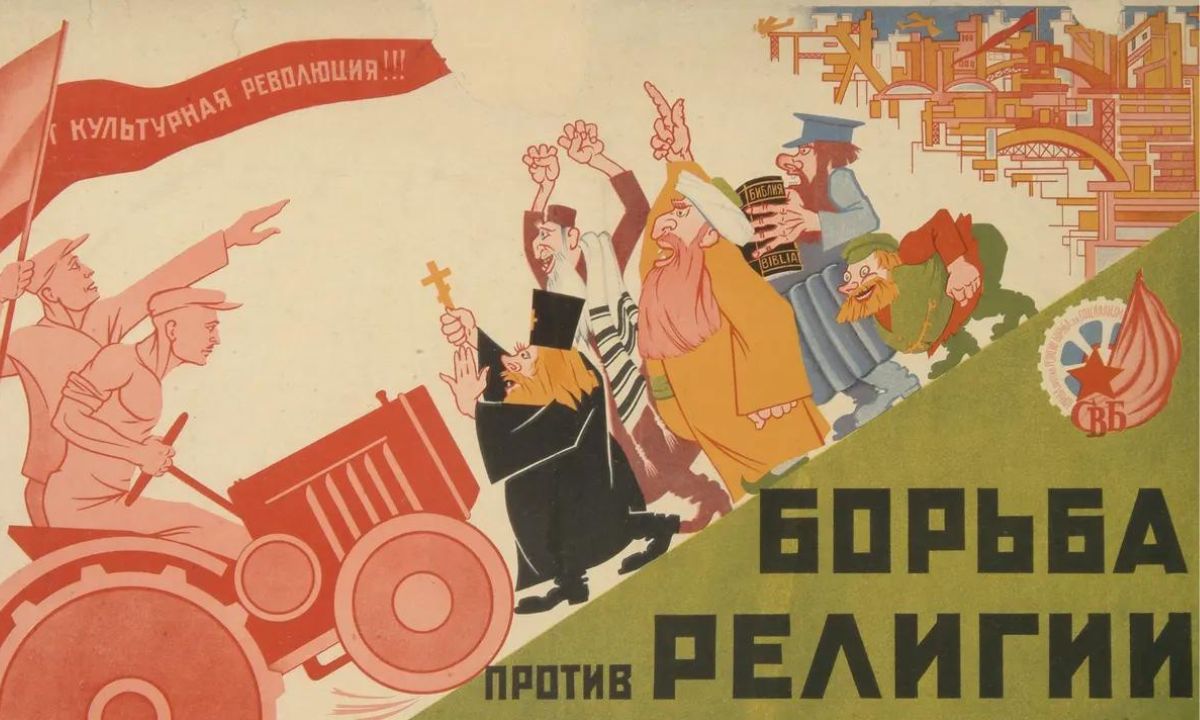
The attitude of t he Bureaucracy towards the Church has passed through the usual zig-zags of Stalinist policy. During the ultra-left period of forcible collectivisation and the Five Year Plan in Four an attempt was made to liquidate the Church and its influence by government decree. Starting in 1929 churches were forcibly closed and priests arrested and exiled all over the Soviet Union. The celebrated Shrine of the Iberian Virgin in Moscow – esteemed by believers to be the “holiest” in all Russia was demolished – Stalin and his Government were not afraid of strengthening religious fanaticism by wounding the feelings of believers as Lenin and Trotsky had been! Religion, they believed, could be liquidated, like the kulak, by a stroke of the pen. The Society of Militant Atheists, under Stalin’s orders, issued on May 15th 1932, the “Five Year Plan of Atheism” – by May 1st 1937, such as the “Plan”, “not a single house of prayer shall remain in the territory of the USSR, and the very concept of God must be banished from the Soviet Union as a survival of the Middle Ages and an instrument for the oppression of the working masses.”!
Unfortunately for the Stalinist “Plan”, during the very period when it was proclaimed, the Bureaucracy was actually strengthening the social basis of religion in the Soviet Union – by the ever increasing miseries which its disastrous economic policy was imposing upon the masses. The Great Famine of 1932-1933 in which millions died in the Soviet Union did more for the strengthening of the hold of the Church over the masses that could have been done by any amount of religious propaganda. Like so many other Stalinist “Plans” of this period, the “Five Year Plan of Atheism” was officially forgotten long before the time for its fulfilment was due.
It is of interest to note that even during this period-the first since the Revolution-of undoubted religious persecution, the servile head of the Orthodox Church, the Acting-Patriarch Sergius, found it possible to declare, at a stage managed interview with foreign correspondents, that: “There never has been, nor is there any persecution of religion in the U.S.S.R.” The Orthodox Church was even then quite willing to put its services at the disposal of the Stalinist Bureaucracy in the same way as it had given them to Tsarism, only the Stalinist Bureaucracy did not want them!
But it had not long to wait. The Left zig-zag of the bureaucracy was inevitably followed by a turn to the right. The anti-religious processions which had been organised during the Church festivals of Christmas and Easter were abolished; the sale of Christmas trees was allowed once more; exiled priests were allowed to return to their parishes. But Stalin hastened to go even further than relaxing the pressure against the Church-he gave it rights that it had never previously enjoyed since the Revolution. In the New Constitution of the U.S.S.R. of 1936 priests were given the right to vote and to be elected in Soviet elections.
Nevertheless the alliance between Stalin and the Orthodox Church was not yet finally cemented. In the period of mass purges of 1937 the attack upon the Church was for a short time resumed. Once again priests were arrested and banished and in January 1938 the “Society of Militant Atheists” accused the Clergy of being in the service of the military staffs of Fascist States, of disorganising the Army, of trying to wreck railways, etc., etc.
But this renewed attack was very speedily followed by an even more drastic swing to the Right, a swing which reached truly remarkable proportions after the German invasion of the U.S.S.R. Not only did all Government pressure upon the Church cease but all anti-religious propaganda also. The “Society of Militant Atheists” had built up a huge publishing concern which in ten years had published 1,700 books and issued magazines with a circulation of some 43 million copies. The whole undertaking was closed down upon the grounds of “paper shortage”. At the same time school textbooks were revised and anti-religious passages removed. Anti-religious tests for the Army and Civil Service were abolished.
In return the Church entered enthusiastically into the service of the Stalinist Bureaucracy. The following message sent by Sergius, the Acting Patriarch, to Stalin, on the occasion of the 25th anniversary of the October Revolution (November 1942) gives eloquent proof of this:
“On this 25th anniversary of the Republic of the Soviets, in the name of our Clergy and of all the believers of the Russian Orthodox Church, faithful children of our Fatherland, I salute with cordiality and piety, in your person, the leader chosen by God, the leader of our military and cultural forces, who is guiding us to triumph over the barbarous invasion, to the prosperity of our country in peace, towards a radiant future for its peoples. May God bless by success and glory your valorous exploits for our Fatherland.”
Similar messages were sent on this, and all other suitable occasions by all the main dignitaries of the Orthodox Church. The War in fact brought with it nothing more nor less than the incorporation of the Russian Orthodox Church into the Stalinist Bureaucracy, with all the privileges that this entails. Some idea of these latter can be gleaned from the contribution made by ecclesiastical dignitaries to the Soviet war effort, as published in the Soviet Press. For instance, on December 27th, 1942, Alexander Alexandrovich Troitski, priest of the parish of Chubino, writes to Stalin announcing that he has already subscribed 30,000 roubles, “taken from my own savings” towards national defence. Now, he states, “I have decided to buy, with my savings, an aeroplane for the Red Army, and I am remitting for this great work the sum of a hundred thousand roubles. I have already paid in fifty thousand of them to the State Bank and I will remit the fifty thousand remaining on January 15th 1943.” It must be noted that Alexander Alexandrovich Troitski is no highly placed ecclesiastic, but merely a parish priest. It must also be remembered that the average monthly wage of a Soviet worker, upon the eve of the present war, was 300 roubles. In other words this parish priest has been able to amass savings so vast that he is able to give from them to the State a sum equal to the total earnings of a worker for more than eight years. What must the income of the parish priest be like?
Nor is this merely an isolated instance. Many others exist of similar huge sums being given by the relatively lower ranks of the hierarchy of the Russian Orthodox Church. The priest of the Church of the Assumption, for instance, announces to Stalin on January 4th, 1943, that he has already paid into the State Bank, “All my personal savings, amounting to 273,000 roubles. I beg of you, Joseph Vissarionovich,” he continues, “to have built with this money two war planes, giving them the names of heroic ancestors Alexander Nevsk and Dmitri Donskoi.”
The higher up one goes in the Church hierarchy the greater become the sums subscribed. For instance, on January 5th, 1943, Alexis, Metropolitan of Leningrad, informs Stalin that his Bishopric has already subscribed 3,182,143 roubles; he is now adding to this a further 500,000 roubles! He finished up with the statement that, “We pray to God that he may aid you in your great historic mission; to defend the honour, the liberty and the glory of our fatherland.”
In each case a polite, if somewhat brief, reply is sent by Stalin and published in the press. For instance, the above mentioned priest of the Church of the Assumption received the following answer:
“I thank you, Vladimir Alexandrovich, for your solicitude for the Red Army Air Force. Your desire shall be granted. Receive my greetings,
J. Stalin.”
Nor was it long before Stalin gave his loyal supporters of the Russian Orthodox Church an appropriate recompense. In the official Soviet Daily, “Izvestia”, on September 5th, 1943, there appeared the announcement that Stalin had received leading Church dignitaries in the course off which, “the Metropolitan Sergius informed the President of the Council of Peoples Commissars that the leading circles of the Orthodox Church had the intention of calling together in the near future a council of bishops with the object of electing the Patriarch of Moscow and of all the Russians, and of forming a Holy Synod alongside the Patriarch.”
The head of the Government, J. Stalin, showed himself sympathetic to this possibility and declared that there would be “no objections on the part of the Government.”
On September 8th, 1943, the Church had its wish-it elected a Patriarch, for the first time since the Kerensky period. Nor was that all-an official link was established between the Russian Orthodox Church and the Soviet State. There exists today a “council for the affairs of the Russian Orthodox Church attached to the Council of Peoples Commissars of the U.S.S.R.” When in January of this year a Church Assembly met in order to elect a new Patriarch to replace Sergius who had recently died, it was greeted by a speech by G.G. Karpov, the President of this Council for the affairs of the Russian Orthodox Church. He informed the assembled ecclesiastics that:
“The Government of the Union of Soviet Socialist Republics has authorized me to convey to the present High Assembly greetings in the name of the Government and best wishes for successful and fruitful work for the construction of the Highest Church Administration.
“I am deeply convinced that the decisions of the Assembly will serve toward strengthening the Church and will be an important starting point [for] the future development of the activities of the Church, which are directed towards assisting the Soviet people in the attainment of the great historical tasks before it.”
But Karpov does not stop here; he goes on to give a new appreciation of the past of the Church. Lenin, writing in 1901 (“Socialism and Religion”) referred to “that shameful and accursed past when the Church was in feudal dependence on the State, and Russian citizens were in feudal dependence on the Established Church.” Not so Karpov today. “The Russian Orthodox Church,” he announced, “in the days of hard trial, which our Fatherland repeatedly underwent in the past, did not break its link with the people, it lived with their needs, their hopes, their wishes and contributed its might to the common struggle… many leading members of the Church sacrificed their lives for the good of the Fatherland.”
It is hardly surprising under these circumstances that the Assembly was able to state in the message which it sent to the Soviet Government:
“Our Church thanks to God, lives with a full life, according to our laws and to the customs of the Church. In all its activities our Church meets with full co-operation in its needs from the Government and in first place from the Council for the Affairs of the Russian Orthodox Church attached to the Sovnakom of the U.S.S.R.”
At every step now, the Orthodox Church hastens publicly to announce its support for Stalin and his policy. For instance, in “Izvestia” of February 17th of this year one meets the heading “The Most Holy Patriarch of Moscow and of all Russia on the decisions of the Crimea Conference.” In it we read, “The Church blesses these bright Christian wishes and hopes; and redoubles its prayers to ‘the Lord of Hosts’ and the ‘Prince of Peace’ (Isaiah, IX, 6.)” etc. etc.
The priests of the other Churches existing in the U.S.S.R. do not lag behind their Orthodox brothers in their expressions of loyalty to Stalin and his Government. Thus Abdurakhman Rassolev, Mufti of the Central Spiritual Direction of the Mussulmans, sends his congratulations to Stalin on the occasion of the 26th Anniversary of the October Revolution and ends with these words:
“May Allah aid you to bring to a successful conclusion your glorious efforts for the liberation of the oppressed peoples. So may it be.”
Similar greetings are sent on the appropriate occasions by the Jewish Clergy. Thus Stalin has secured the backing not only of Christ, but of Allah and Jehovah also!
All accounts from the Soviet Union during the past few years agree that never since the Revolution has religion had such a hold over the mass of the population. We read of church services being attended by thousands, including young workers and soldiers of the Red Army. According to “Soviet War News” of August 22nd 1941, there existed at that time 30,000 religious associations of all kinds in the Soviet Union. An English clergyman, Canon Widdrington, has estimated the number of supporters of the Orthodox Church alone to be some 60,000,000 persons.
The conclusions to be drawn from all this are sufficiently obvious. In the first place there is no question of religion dying out in the Soviet Union as would be the case in a society which was advancing towards Socialism. Thus is the lie given, by this fact alone, to the Stalinist claims to have “finally and irrevocably” established Socialism in the Soviet Union. On the contrary, religion is maintaining and increasing its hold over broad sections of the Soviet masses. This is undoubtedly due to the increasingly capitalist nature of income distribution within the Soviet Union. Without the Bureaucracy having become a class, and with the basic economic conquest of the October Revolution as yet still in existence, the Bureaucracy has taken for itself an ever-mounting proportion of the national income of the Soviet State. The inequalities between the position of the bureaucrats, with their incomes of tens and hundreds of thousands of roubles and that of the workers with their few hundreds, have assumed a capitalist character. At the same time, despite all the empty boasting about “social security”, the masses still live miserably and at the mercy of economic forces which neither they nor the Bureaucracy can control. True, these uncontrolled economic forces no longer, as in the capitalist world, threaten the masses with unemployment, but they affect them in equally significant ways-through periods of famine or semi-famine, through the chronic shortage of goods of all kinds, a shortage which is continually assuming acute forms in one sphere or another, or through drastic forced movements of population. Moreover the very nature of the rule of the Bureaucracy itself means that the lives and the liberty of the masses are constantly threatened by a force over which they have no control and the actions of which they cannot foresee.
The social roots of religion, the fear of the uncontrolled social forces which dominate the masses in their daily lives, “the impotence of the exploited classes in struggle with the exploiters”(Lenin), not only still exist in the Soviet Union, they are being strengthened as the degeneration of the Bureaucracy proceeds and the burdens which it heaps upon the masses increase.
In the second place there has ceased to exist any reason for a schism between the Bureaucracy and the Church. The bitter hatred of the clergy for the Bolshevik Party of Lenin and Trotsky which represented the toiling masses and was working for the establishment of a classless society is not extended to their degenerate Stalinist successors who represent a usurping caste anxious only for the maintenance and extension of its own position and privileges. With such a caste it is possible for the clergy to come to terms in the same way as they have been able to come to terms with ruling and exploiting classes throughout history. True, in the present case the terms that the clergy have received have not as yet been particularly good, though they steadily improve with time. But that is because even Stalin’s Russia is still not yet capitalist Russia and the effects of the terrific blow that the October Revolution dealt at religion have not yet disappeared; broad sections of the masses still contemptuously turn their backs upon religion.
Stalin, therefore, does not, at least as yet, need the services of the Church so urgently as the Tsar did. But need them he does nevertheless. Inevitably, under the conditions of the rule of the Bureaucracy, the Church must command the support of broad sections of the population; Stalin cannot destroy this support by administrative means-he has tried and failed. He must therefore secure an agreement with this Church which he cannot crush in order to secure the hold of the Bureaucracy over the Soviet masses, for the nature of his regime does not permit the existence of an independent and potentially hostile force within the Soviet State.
As we have indicated, such an agreement was not difficult to arrange. And today Stalin who in his interview with the First American Trade Union Delegation (September 1927) once stated “The Party cannot be neutral with regard to religion, and it conducts anti-religious propaganda against any and all religious prejudices because it stands for science, while religious prejudices go against science, since every religion is something contrary to science.”-that same Stalin today is not neutral towards religion but gives it active, if as yet limited support, for which he receives public thanks from the clergy.
The Church then is today an integral, though subordinate part of the Stalinist state machine and the clergy enjoy the privileges accorded to the members of the Bureaucracy. With the continuation of Stalinist rule and of Stalinist degeneration we may expect the alliance not only to continue but, by and large, to be strengthened with increasing privileges granted to the clergy. This does not, of course, signify that there may not take place in the future conflicts, and sharp ones at that between the Bureaucracy and the Church. Such conflicts will take place between sections of the Bureaucracy itself and have taken place in the past between ruling classes and their Churches. But the general tendency will be one of increasing integration.
Only the overthrow of the Stalinist Bureaucracy and the restoration of direct proletarian rule in the Soviet Union can, in alliance with the World Revolution, destroy the new privileges which religion is gaining and pave the way for the destruction of religion itself.
October 1945