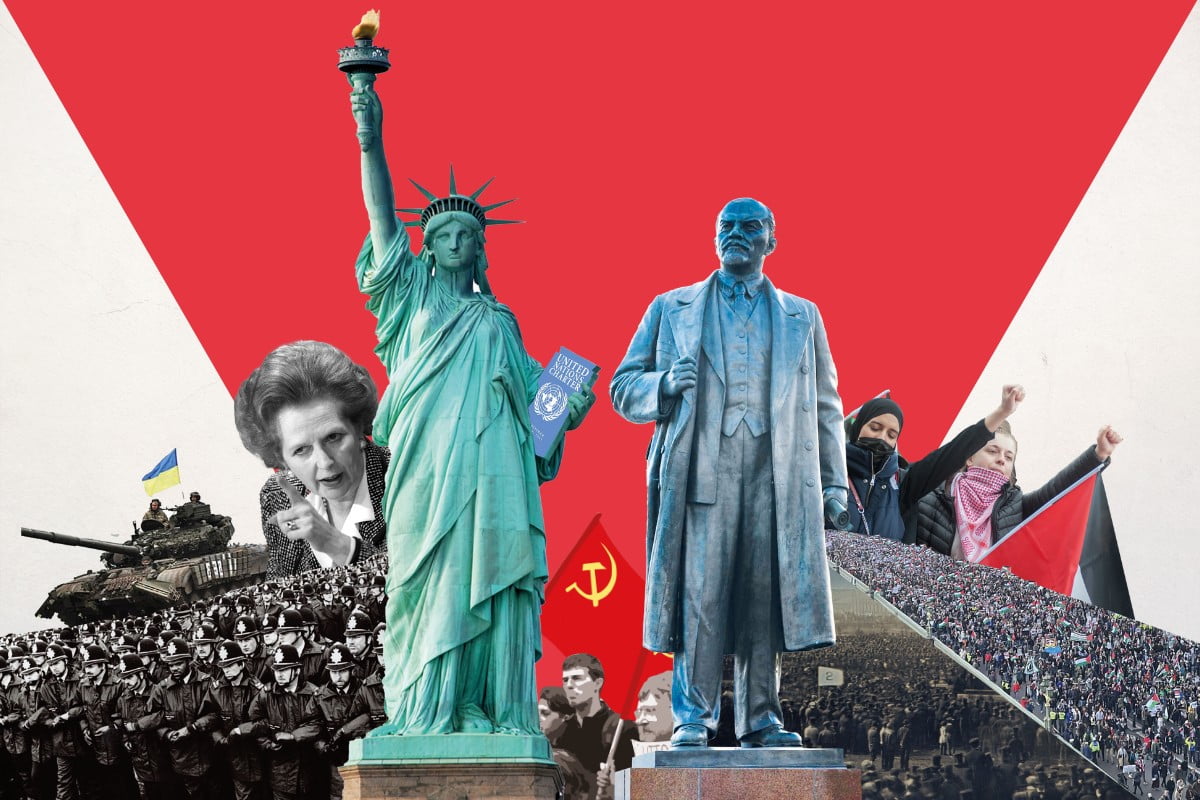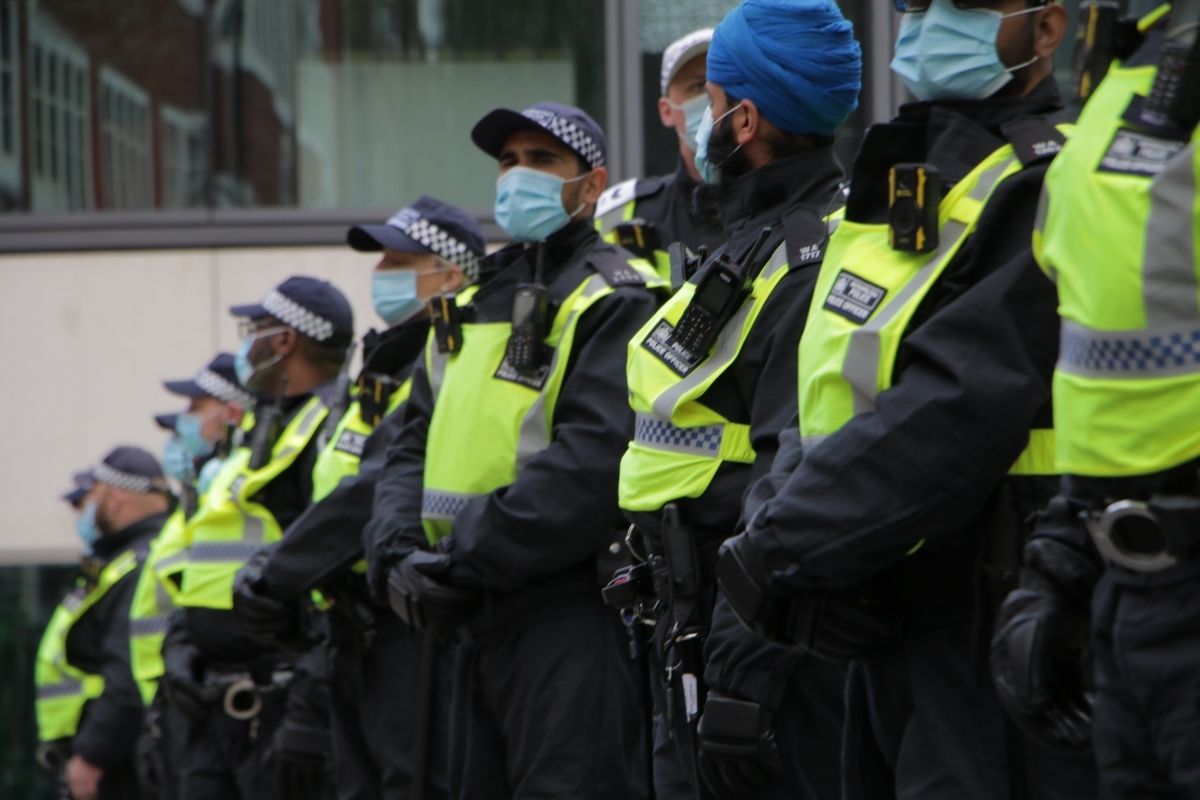
Standing between the working class and the socialist transformation of society is a colossal state machine. In order to carry out this transformation, we must have a clear understanding of what the state is, and what must replace it.
In their writings on the state, Marx and Engels set themselves the task of demystifying it, of conquering the idea that the state is some kind of eternal being, in order to strip away the magical shroud in which capitalism has cloaked it.
Today the bosses dress up their attacks on workers rights, the right to strike etc., in the name of the Law with a capital “L”, or Democracy with a capital “D”. When the police and the government defend the “right” of a scab to break a strike, they do it in the name of his “democratic right to work”. When a million and one obstacles are placed in the path of workers taking action, it is in the name of legality. When huge sums were confiscated from the printers and the miners, it was all dressed up as obedience to the Law. As if the law or democracy, the courts or the police, are all independent entities removed from the issues and conflicts involved.
Surely, they say, the Law is a set of fair rules which everyone must obey. In reality we all know there is one law for the rich and another for the rest of us.
In the crudest way, with judges dressing up in wigs and robes (and isn’t it the same in Parliament) they perform absurd rituals to draw a mystical veil over their real purpose.
By dressing up in costumes, spouting a few Latin phrases and calling it the law, the ruling class believe we will all stand in awe, fearing to break the natural order of things, God’s word or some such mystical nonsense.
Yet the law wasn’t written in heaven it was written on earth and to serve a purpose. In whose interest is it to limit the number of pickets allowed at a factory gate, or to deny workers the right to join a union as at GCHQ, to make it illegal for whole sections of workers to go on strike, or to rewrite laws which previously gave workers at least some health and safety protection.
The law isn’t a system of “fair rules”, it’s just like any other aspect of the state – a means of coercion by which one class in society, the ruling class, the minority, maintains its rule over the majority, the working class.
To sweep away this supernatural fog which surrounds the state, we must first deal with the idea that this machinery has always existed. In fact, for nine-tenths of mankind’s existence on the planet there was no state.
Historical Stage

There is a vulgar view of history which states that things are as they always have been and always will be. Capitalism has always existed, and so has the state, the impartial observer and referee in society.
In truth, capitalism is an historically recent stage in our development, and the state, although older, was certainly unknown in early tribal society.
In order for society to advance from its primitive communist, tribal beginnings, to the rational and harmonious self organisation of society which would be socialism, it has already been necessary to pass through all kinds of convulsions and revolutions, and we aren’t there yet. We have had to pass from one form of class rule to another, one form of property ownership to another, one kind of state suppression to another, in order to lay the economic, cultural and scientific basis for a genuinely classless society.
In those earlier classless societies, which make up 9/10ths of mankind’s existence to date, there could not be a state, there couldn’t even be “civilisation” because man lived on a nomadic basis. They were an armed people with no need for special groups of armed men, no need of a special coercive force or state to keep one section of the population oppressed.
This was not lawless anarchy, crimes and misdemeanours were dealt with democratically by the community, and of course there were “leaders” as in all human societies, people with authority, respected by the community, but no special force to impose their will, only a voluntary respect for the elders.
As Engels wrote in his Origin of the Family, Private Property and the State:
“The shabbiest police servant of the civilised state has more “authority” than all the organs of gentile society put together; but the mightiest prince and the greatest statesman or general of civilisation might envy the humblest of the gentile chiefs the unforced and unquestioned respect accorded to him. The one stands in the midst of society; the other is forced to pose as something outside and above it.”
Accumulation

When man began to settle in specific territories it was possible to develop the productivity of his labour, not just by hunting or taking what nature provided, but by planning, the sowing of seed, the development of tools and technique. As a consequence they began to develop a surplus above their own immediate needs. For the first time a section of the population was freed from the day-to-day struggle for existence, a class was created which could “employ” the labour of others to sustain it. Now there could be accumulation, the manufacture of tools could be developed, as could primitive agricultural techniques, and of course the military means for defending the settled areas against incursion from nomadic tribes.
For the first time society was divided into classes, and there developed the “haves” and the “have nots”, which in the first instance were the slave-owners and the slaves.
The new ruling class of slave-owners was free to devote its time to an enormous flourishing of human achievement in art, science, architecture, philosophy and mathematics. This was the basis for the development of the ancient societies of Greece and Rome which we associate with great cultural and scientific advance.
These slave-owners were, of course, a minority and as such required special bodies of armed men to keep their slaves in chains, and so the state was born of the division of society into classes.
The new state was distinguished from the old gentile order in that it was no longer held together by blood ties but divided its subjects on a territorial basis. Citizens were now required to carry out their public rights and duties according to where they lived regardless of their tribe or gens.
The other distinguishing feature of this new state was the creation of a public power which no longer coincided with the population organising itself as an armed force. “Special bodies of armed men” came into being because an armed population divided into opposing classes, would have led to interminable conflict.
Engels in his Origin of the Family, describes the state as
“a product of society at a certain stage of development; it is the admission that this society has become entangled in an insoluble contradiction with itself, that it has split into irreconcilable opposites which it is powerless to exorcise. But in order that these opposites, classes with conflicting economic interests, shall not consume themselves and society in fruitless struggle, it became necessary to have a power seemingly standing above society that would moderate the conflict and keep it within the bounds of “order”.”
In his masterpiece on this subject, State and Revolution, Lenin summarises the origins of the state as follows
“The state is a product and manifestation of the irreconcilability of class contradictions. The state arises where, when, and to the extent that class contradictions objectively cannot be reconciled. And conversely, the existence of the state proves that class contradictions are irreconcilable.”
So this system of police, courts, army, civil service and so on aren’t eternal protections against anti-social and criminal behaviour, but were created in their basic, crude, initial form as a special machine for the suppression of the majority by the minority – the slaves by the slave-owners.
With each succeeding form of class society, this state machine was taken over and perfected as the instrument of the new ruling class – the feudal state was the organ of the nobility for holding down the peasant serfs and bondsmen, and the modern representative state is an instrument for the exploitation of labour by capital.
In all the bourgeois revolutions which brought the capitalists to power, in Britain in 1649 or France 1789, the new ruling class took over the old state apparatus and perfected it as an instrument for the suppression of the new exploited class, the working class.
Surely the bosses cry, this is all socialist paranoia. Do we really believe the bankers and directors of big monopolies sit around in their gentlemen’s clubs inventing this great apparatus to keep us in check. Leaving aside the question of what these gentlemen discuss in their clubs, they certainly could not have dreamed up, such a scheme as the modern state, they wouldn’t have the imagination. No, it devolved through revolutions and changing social conditions over centuries.
Paris Commune

In all these earlier revolutions, this state machine was seen as the principal spoils of the victor. Marx and Engels, however, explained that the task of socialism would be entirely different. And here we see, as in all the works of Marx, there is not one ounce of utopianism. He didn’t dream up the tasks of the workers in relation to the state, but drew instead on the practical conclusions of the experience of the Paris Commune of 1871.
Whilst praising the heroism of the Communards “storming heaven”, Marx re-examined his theory in the light of their defeat. In fact the only correction Marx felt it necessary to make to the Communist Manifesto was on the basis of that revolutionary experience.
In the preface to the June 1872 edition Marx and Engels say that the programme “has in places become antiquated” and go on to quote from Marx’s book The Civil War in France, “the working class cannot simply lay hold of the ready-made state machinery, and wield it for their own purposes.”
Reformists
Amazingly, this came to be crudely misinterpreted by many leaders of the labour movement as an argument in favour of slow gradual change, piecemeal reforms, by which the state could be improved in the interests of the workers. The leaders of the German labour movement, for example, demanded a “free people’s state”. Marx ridiculed this idea “What do you mean a free people’s state – the state is an instrument for the suppression of the working class nothing else!”
The state in so far as it is a state will be there to suppress the people, and in so far as it becomes an instrument of the people it ceases to be a state.
Lenin took up this idea when the leaders of the European socialist and Labour parties held up their hands in horror at the Russian Revolution, prattling on about abstract democracy, democracy with a capital D. “There is no such thing as “democracy”,” he said “there is bourgeois democracy or there is workers’ democracy…Bourgeois democracy, although a great historical advance in comparison with mediaevalism, always remains…restricted, truncated, false and hypocritical and a snare and a deception for the exploited and the poor.”
Even our own Parliament is just such a snare of course, where we choose every few years which members of the ruling class will represent (read repress) us for the next few years.
What Marx actually meant in saying “the workers can’t simply lay hold of the ready made state machine” he clarified on many occasions. In a letter to Kugelman, for example, he writes, “If you look at the last chapter of my Eighteenth Brumaire, you will find that I declare that the next attempt of the French Revolution will be no longer, as before, to transfer the bureaucratic-military machine from one hand to the other, but to smash it and this is the preliminary precondition for every real people’s revolution on the continent.”
In Britain today, where Parliamentary traditions go back furthest, who really makes the decisions? Not the government or the cabinet, but the bosses of the banks and the big monopolies, the currency speculators and the stockbrokers – and who elected them? For that matter who elected the judges, to whom are the police commissioners accountable? Who elected the press barons, who, not content with telling us who to vote for in the general election, are now telling us who to elect as Labour leader.
Of course Marxists are the first to defend all the democratic rights which the workers have conquered through struggle, and fight to extend them – the right to strike, to organise, to free speech, many rights which even now are being eaten away.
More than that, Marxists would argue to use Parliament, the council chamber, even the courts where possible to defend or advance our rights – but these elements of the state machine are not the goal itself, they are a means to an end.
Engels

In the Communist Manifesto, Marx and Engels explain that the democratic gains of the workers are “just a certain amount of rights, for the exploited class to go some way towards the goal of fighting for a change in the class system for a new society, but that is all.”
“The state” Engels added later “is a machine for the oppression of one class by another and indeed in a democratic republic no less than in a monarchy…In a democratic republic wealth exercises its power indirectly, but all the more surely, by means of the direct corruption of officials; second by means of an alliance between the government and the stock exchange.”
The capitalists themselves prefer democracy as a cheaper and more malleable system, but as the ex-Tory MP Ian Gilmour once explained, for the bosses too this is only a means to an end, if it threatened the continuation of capitalism the ruling class would not hesitate to end it. In the early 1970s, in Britain, Brigadier Kitson and co. prepared a coup in case the Labour government attempted to implement the socialist measures in their programme. More recently we have the Gladio conspiracy of the security forces throughout Europe preparing for future military takeovers.
Look at the way the South African state aided and abetted the reactionary Inkatha movement, or the military coups throughout Latin America and Africa in the 70s and 80s. Look at the way every tentacle of the state machine was employed against the miners in the strike of 84-85, the courts sequestrating funds, the police and the army on picket lines and demonstrations, the blatant lies and distortions of the media.
How could the workers possibly “lay hold of” and use this state machine. Surely this nails the arguments of reformism, the idea that society can be changed gradually, slowly but surely over generations. Capitalism hasn’t perfected this colossal machine in order to allow itself to be reformed out of existence.
The task of Marxism is to lay bare the truth about the state and the danger it represents to the working class, but also to explain what should replace it and how.
Marxism has nothing in common with anarchism which preaches that all authority and organisation is inherently evil – this is just mysticism.
Without some form of state how could the trains run on time, how could the harmonious development of the economy, of society that socialism represents be planned.
Workers’ Democracy
While the capitalists need a state to maintain class rule, the workers need one precisely to end it. (On the basis of modern science such a period could be short lived as the workers lead the whole of society towards socialism.) Since any state only exists for the suppression of one class by another, the workers state, workers democracy, would be the rule of the majority over the minority, just as bourgeois democracy is the rule of the minority over the majority.
The first task of such a regime would be to appeal to workers throughout Europe and internationally to join forces in putting an end to the anarchy of capitalism and begin building a socialist society. Its first act should be the nationalisation of the commanding heights of the economy, taking the ownership of the means of production out of private hands and converting them into state property, under the democratic control and management of the workers themselves.
A government with such a programme would of course be sabotaged from the beginning by the state. Equally such a programme could inspire millions of workers to come to its defence and carry its programme out in practice, taking over the factories and the banks.
In so doing, the workers begin to do away with themselves as a class, to do away with all class division in society, to do away with the state as a state. As Engels wrote, “The first act in which the state really comes forward as the representative of the whole of society – the taking possession of the means of production in the name of society – is at the same time its last independent act as a state. The interference of the state power in social relations becomes superfluous in one sphere after another, and then dies away of itself. The government of persons is replaced by the administration of things and the direction of the processes of production.”
Superabundance

Again there is not a single ounce of utopianism here. Marx didn’t invent some new perfect social order in his head, but studied the birth of a new society from within the old. The aim of the socialist transformation is to put an end to class divisions, to create a society where Marx’s aphorism “from each according to his ability, to each according to his needs” could become a reality. That requires the development of an economy of superabundance, entirely possible on the basis of modern science and technique, once we’ve done away with the anarchy of the market.
The building of such an economy requires conscious planning and organisation of “production, distribution and exchange” as the old Clause 4 of the British labour Party used to put it.
The government of people must be replaced by the administration of things. This would be the remit of the new workers state, which from the beginning would be only a semi-state, withering away of its own accord in one sphere after another.
All administration might not be abolished over night, but bureaucracy could be. The working week could be cut immediately to 32 hours, without loss of pay and then to four 6 hour days and beyond, not only eradicating unemployment, but providing everyone with the necessary time to participate in the running of all aspects of society. In Lenin’s words “when everyone is a bureaucrat, no-one is a bureaucrat.”
The old liberal dream of cheap government would become a reality by doing away with the two most greatest expenditures. Firstly, state functionarism – such administrative tasks would be reduced to what they really are, stripped of power and prestige, they would be bookkeepers and technicians paid workers wages.
All officials would be elected and moreover subject to an immediate recall. All parties, except the fascists, would be allowed to organise. The enormous waste of resources on the “special bodies of armed men” to keep us in our place would also become unnecessary. Crime, security and so on could be dealt with by society without this colossal state machine.
The state, then, has not existed for all eternity. There have been societies that did without it, that had no need of it. At a certain stage of economic development which necessarily involved the split of society into classes, the state arose because of this split. Today this class division in society is not only no longer a necessity, but is now a hindrance to the further development of humanity. The task of the socialist transformation of society, is to free us from this ball and chain. Then as Engels explained, “Society, which will reorganise production on the basis of a free and equal association of the producers, will put the whole state machinery where it will then belong – into the museum of antiquities, by the side of the spinning wheel and the bronze axe.”
Before Marxism can conquer the state, however, it must first conquer the labour movement. To grasp the nature of the state, to bring its history, its character, its role to the attention of the workers is the duty of Marxism, the theoretical expression of the workers movement, the guide to action.