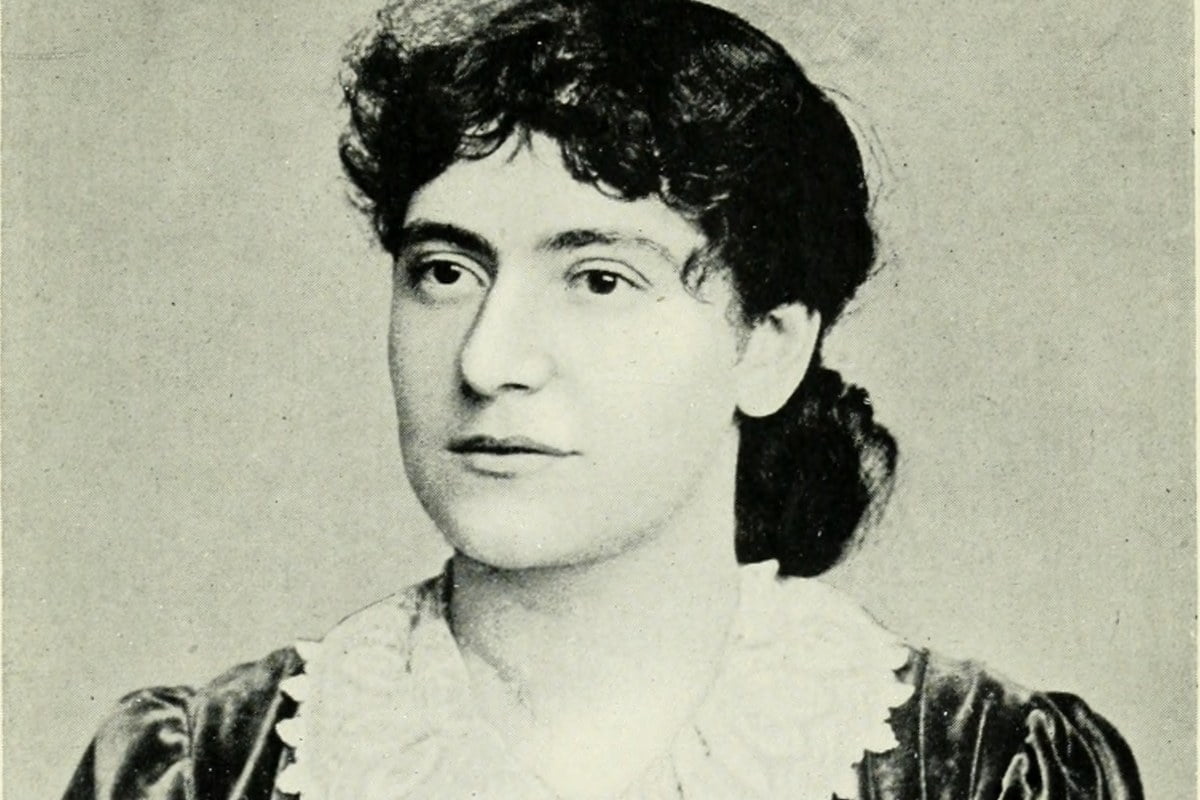

Eleanor Marx was the youngest daughter of Karl Marx, the greatest philosophical, political and social thinker of our times.
She was born in Soho in London in 1855 and, not surprisingly, was a precocious child mixing with adults who were the most advanced political thinkers of their day. But her place in history isn’t because of her name and who she was related to. Her work, commitment to the cause and self sacrifice earned her that place in her own right.
From the time of her father’s death in 1883 until her own untimely death in 1898 the workload she undertook in the labour and trade union movement of the day was phenomenal.
Socialist organiser
 She was involved in the first attempt at socialist organisation in Britain, belonging to the Social Democratic Federation whose leader Henry Hyndmanhad had an imposing and undemocratic approach. His jingoistic attitude was an anathema to Eleanor who was a true internationalist.
Unfortunately Eleanor and others, most notably William Morris and her partner Max Aveling decided to split from the SDF and set up their own socialist organisation the Socialist League. Eventually this organisation fell into the hands of the anarchists and she ended up in the Bloomsbury Socialist Society that used to be the branch of her old Socialist League organisation.
While this party hopping was clearly a mistake and, as every good socialist will tell you today, the right thing to do is to stay and fight for change it must be remembered that these people were pioneers and had no guidance from the past as these were the first socialist organisations in Britain.
Despite the mistakes there was also the incredible work Eleanor and others undertook. As well as writing first for the SDF’s magazine ‘Justice’ and the League’s paper ‘The Common Weal’ she was always speaking at internal and public meetings the length and breadth of the country, translating much of her deceased father’s work while at the same time working to try and make a living, it was a stunning testament to her commitment.
At that period in history Britain was the most advanced capitalist country in the world with a sophisticated state system and the most organised legal and judicial system “by the rich for the rich” backed up with a judicial system,a prison service, a police force and not forgettingher majesty’s troops – who wore red in those days. All of this to ensure things ran smoothly for the capitalist and rump feudal/aristocratic classes. However giving credit where it is clearly due the tiny socialist propaganda circles had popularised the ideas of socialism so effectively that the ruling class were worried.
The fight back
 A year after the events in Trafalgar Square that became known as Bloody Sunday the match girls’ strike was the spark that set the East End alight. These women working in the most horrific condition for paltry wages, got organised, went on strike and won.
Early the following year and after several abortive attempts the gas workers from the Beckton plant in East London formed the Gas Workers and General Labourers of Britain and Ireland Union. After a war of words and a rapid expansion of union membership throughout London a famous victory was achieved without a fight. A third shift was created by management in the Beckton Gas Works and eight hour shifts introduced, reducing the working day from twelve to eight hours.
Eleanor was not involved in these battles but she was involved in the biggest confrontation of them all that took place next,the battle for the docker’s tanner when tens of thousands of men in London’s docks came out on strike over the appalling conditions. Totally disorganised, the men would wait outside the gates hoping to be called for a few hours work for a few coppers, (a practice that is creeping back now after over a century, so weak have we allowed our unions to become).
Eventually awakened by socialist agitation and encouraged by the successes of the match girls and the gas workers, the dockers got off of their knees and started the fight back. They went on strike.
The strike went on throughout the summer of 1889 and ended in victory, opening up the floodgates of new unionism. Each day and night Eleanor would be working at the strike headquarters or speaking at meetings in support of the strike, raising and distributing strike funds. Strike leaders were amazed at the level of work undertaken and the fact that this “brave woman would walk home on her own after many hours work at the strike headquarters”.
No sooner had this strike ended than another one begun at an india rubber works in Silvertown in the most desolate reaches of the East End. The strike, which involved nearly a thousand workers, was over hourly rates but was defeated. These workers didn’t have the power to bring the commerce of the richest city in the world to a standstill.
The strike lasted for twelve weeks and Eleanor again was down there each day every day speaking and organising. She organised the workers into the Gas Workers’ Union and also organised the first women workers’ branch of the union.
It was during this strike that Eleanor witnessed some of the most horrific suffering of the striking workers and their families, it was at this period that she matured and a more level headed approach prevailed. On one occasion she offered a women worker “whose children were literally climbing the walls with hunger” money from the strike fund and the woman couldn’t sign for it because she couldn’t read and write. She didn’t want it anyway, she wanted food. There is no doubt that Eleanor would have got this woman sorted out, but the significance of the incident was that knowing only the working class could bring about its own emancipation Eleanor realised there was a very long way to go. Exulting starving, unarmed, illiterate men to fight the best state machine capitalism could throw at them was perhaps not the best way forwards.
General unionism
Eleanor had learnt what thousands of other socialists have since, but many hundreds of thousands have not. We have to build industrial/general unionism (as opposed to “trade” unionism) based on the knowledge we have acquired as socialists.
Eleanor threw herself into the work, getting involved in strikes of the Cross and Blackwell workers in North East London and the women who worked in an onion factory in the East End. While she was in Chatham in Kent recruiting workers to the union she was elected on to the executive committee of the Gas Workers’ Union.
Will Thorne, the first General Secretary of the Gas Workers, had been deprived of his childhood and a basic education by being forced to work from the age of seven. It was Eleanor who helped improve his reading and writing and it was Eleanor who prepared the Union’s first set of accounts. Will Thorne, being the man he was, had worked three full nights on the trot to try and get them done and was at the end of his rope, as anyone who has had to do accounts will fully understand. Once again it was Eleanor to the rescue.
Most of the first rule book of the union that is today the 600,000 strong GMB was written by her.
Eleanor and her partner Aveling were instrumental in organising a monster demonstration in Hyde Park in support of the legal eight hour day in 1890. It was estimated that there were over a quarter of a million people in the park that day.
She was elected to represent the gas workers at the TUC that year when the clash of the old guard and the new unions over the issue of the legal eight hour day was at stake with the new unions supporting it and the old guard opposing.
Eleanor wasn’t allowed to participate as a delegate, despite being elected by her Union’s Congress,on the puerile excuse that she wasn’t a manual worker, which was a lie anyway because she earned her living through operating a typewriter. Nearer the truth might have been the fact that they were petrified of such an eloquent and popular speaker,speaking for the cause they were opposing. Besides she was female and they were bigots.
Eventually she got in as a reporter for a socialist magazine and in an example to every waster who treats union conferences and congresses as some sort of a holiday proceeded to take copious notes so as she could report for the magazine but much more importantly back to her union, and the workers who elected her in the first place,accurately and effectively.
There were also international conferences, strikes and disputes too numerous to mention in the course of an article. There was her feminism and tragic personal life that others dwell on at the expense of the really important issues, but the fact is that first and foremost Eleanor was a class fighter who understood socialism better than most, but unlike the majority of that small band who also understood in Britain, in those days she learnt that first and foremost it is in the general/industrial unions that were known as the new unions that created the best opportunities to spread socialist ideasat the workplace and branch level where it matters.
Death and Legacy
 If you don’t organise in these arenas you organise nothing. But for her tragic death in 1898 when she discovered her partner had married another woman behind her back and committed suicide, Eleanor would have been instrumental in the Labour Representation Committee that went on to become the Labour Party that was based on the unions and was, is and always will be a reflection of working class organisation.
Today we have allowed the Labour Party to fall into the hands of the careerists who do not come from the working class, have nothing to do with our class or the unions and seem only to care about three things – me, myself and I.
We will take the Labour Party back but not before we have taken the unions back at branch, workplace and industry level.
Eleanor Marx above all others would have recognised this and thrown herself into the work of building at a rank and file level. Anyone who calls themselves socialist who isn’t prepared to do the same isn’t worth a light.
Long live the memory of our sister