The working class is
facing enormous challenges both in Britain and internationally. We
are facing conditions not seen for generations. The days when not
much seemed to be happening have gone and we have now entered a
period of very sharp and sudden changes, a period of renewed struggle
in the labour movement.
Without doubt, world
capitalist crisis has returned with a vengeance. What has been
astounding is the sheer scale and speed of the economic collapse.
This has resulted in absolute panic in the ranks of the capitalists
internationally. They are, to use Trotsky’s words, tobogganing to
catastrophe with their eyes closed. All their proposed celebrations
to welcome the 20th anniversary of the fall of the Berlin
Wall have been completely overshadowed by a new turn of events: the
biggest crisis of capitalism since the 1930s and the Great
Depression.
Some five months ago
the bourgeois economists were hoping for a different scenario. Last
October, the Financial Times, the main mouthpiece of
finance capital in Britain, produced its own World Perspectives
document. In it, it outlined two frank options:
“At best, it [the
capitalist system] can return to a healthy upward trajectory once the
immediate crisis abates and excesses have been worked out of the
system. At worst, a vicious and unbreakable circle of financial
crisis, recession and further pain for banks could cause the worst
depression in generations.
“Prominent European
economists, organised by the VoxEU.org website, last week likened the
possibility, both economic and political, to the dark years of the
1930s. It is not an exaggeration to say that it could happen again if
governments fail to act.”
So what has happened in
the time between then and today? Last month the Financial
Times again reviewed the situation. “The decline of global
trade, peak to trough, during the Great Depression [was] a little
over 25%… we are not there yet, but on present performance are
getting there fast. What took the global economy 3 years to achieve
between 1929 and 1932 might take us less than a year… the speed at
which global trade has been collapsing is nevertheless breath-taking.
What is frightening is that we do not really understand what is going
on.” (9/2/09)
At least they are being
honest. They have no idea what is taking place. Despite all the
resources at their disposal they are blind to the workings of
capitalism.
“We are not going to
have a recession”, stated Lorenzo Bernaldo de Quiros, chief
economist and chairman of Freemarket International Consulting. “We’re
going to have a depression like in the 1930s. This is the perfect
framework, together with a financial crisis, for a depression.”
(FT, 1/2/09) More recently, Nariman Behrevesh, chief economist at IHS
Global Insight explained, “We are in the midst of the worst
economic storm of the last half century and it keeps getting worse.”
(FT, 1/3/09)
The world economy is crashing and the strategists of capital offer no solutions. Drawing by Latuff.
These are not throwaway
remarks. For the last 25 years, the capitalist class has engaged in
an orgy of speculation, based upon the biggest expansion of credit in
history. Profits boomed and there was an intensification and
expansion of world trade. This allowed capitalism to go beyond its
natural limits. However, there reaches a point when a further limit
is reached and we experience a period of sharp contraction. This was
the credit crunch, which precipitated a collapse in demand, collapse
in the market, the closure of factories, increasing unemployment,
further falls in demand, in a downward spiral. The result is a slump
and a crisis of overproduction.
The sheer scale of the
speculation, accompanied by the biggest debt/credit bubble in history
resulted in a massive slump. As the saying goes, the bigger you are,
the harder you fall. Last autumn, the world financial system was
brought to its knees and the banking system was on the verge of
collapse. Now we are experiencing the wholesale collapse of the
productive forces: industry, technique, science, etc.
The fall in the Gross
Domestic Product (GDP) over the last period has been staggering. In
the last quarter of 2008 (on an annualised basis), the fall in GDP
was:
S. Korea – 20.8%
Japan – 12.7%
Germany – 8.2%
USA –
6.2%
Britain – 5.9%
The decline in
industrial production over the same period was:
Japan – 21%
Spain
– 20%
S. Korea – 19%
Germany – 12%
USA – 10%
Britain –
10%
For the first time
since the Second World War, world GDP is going to fall. However, more
frightening, and more worrying, is the collapse in world trade. This
is very important for what is going to happen in the future. Our
tendency explained many times that the world upswing in the post-war
period was chiefly due to the development of world trade, which was
expanding at a rate of over 12% per year during the 1950s. This was
the main stimulus for the huge rise in world production and the
increase in living standards.
The development of
world trade partially allowed capitalism to overcome its fundamental
limitations for a whole period, namely the constriction of the
productive forces by the restraints of the nation state and private
ownership of the means of production. Capitalism was in fact able to
temporarily transcend its limits.
Now, however, world
trade is collapsing. In the last quarter of 2008, US exports (in
volume) fell by 33.6%. US imports in the same period fell by 21.1%.
Japan’s exports in January (2009) fell by 44%, the biggest fall on
record. Those who looked to China to maintain world growth have been
sorely disappointed. Chinese exports in January fell by 17.5%.
Imports fell by 21.3% in December (2008) and a further 43.1% in
January.
“In a world of
contracting demand China, the world’s leading exporter of
over-capacity, is actually adding to global over-capacity”, states
the FT. “It will be hard to convince China’s trading partners that
this is fair…”
This is a gross
understatement. The slump is producing protectionist tendencies
everywhere, threatening to drag the world economy down even further.
We have already had the “Buy American” stricture written into
Obama’s stimulus package. The French President Sarkozy has berated
French car manufacturers for locating their plants in the Czech
Republic, to the Czechs’ annoyance. The British were prepared to use
anti-terrorist legislation to bring the Icelandic government to heel.
National governments are busy subsidising their industries and
bailing out their banks to safeguard their own national interests.
Protectionism is returning as different governments are attempting
to save their own economies at the expense of others. Photo by Jannie
Jan.
to save their own economies at the expense of others. Photo by Jannie
Jan.
World capitalist
leaders are looking to the G20 summit next month to offer a way
forward. But this could easily go the same way as the economic summit
held in London in 1933 which ended in disarray. The last G20 meeting
was held in November and pledged to maintain free trade. The pledge
didn’t last very long! “The solemn pledge intended to bind
signatories for a year lasted less than 36 hours before Russia said
it would go ahead with planned increases in car tariffs”, explained
the FT. “Moscow’s violation of the pledge was followed by several
other G20 countries – India, Brazil, Indonesia and Argentina –
all pushing for increased protection.” (28/1/09)
The strategists of
capital are terrified that this rise in protectionism will lead to a
depression as in the 1930s or a deflationary crisis similar to the
one that affected Japan for the best part of a decade. The Japanese
attempted to solve the crisis with fiscal packages and zero interest
rates, but to no avail. Roosevelt also attempted to use the New Deal
to rescue capitalism but mass unemployment continued throughout the
1930s. Unemployment did not return to pre-1929 levels until 1943
thanks to the advent of war production.
Now every government
around the world is introducing its own fiscal stimulus package.
Literally trillions of dollars are being poured into the economy in a
desperate attempt to save capitalism. This will have no significant
impact save pushing up government budget deficits to astronomical
levels. The US budget deficit is set to rise to $2.5 trillion. These
deficits will be unsustainable. Obama has already promised to cut the
US deficit by half in four years, which will simply mean a massive
rise in taxes and huge cuts in public spending, basically a programme
of permanent austerity. The same goes for all governments as a new
era of austerity opens up.
The crisis has already
had a major impact on the lives of ordinary working people. In the
USA, some 2 million people have had their houses repossessed. Car
parks have been opened to store cars used as homes for the homeless.
A further 8 million are at risk of foreclosure. California, the
richest state, has plans to cut its $46billion deficit, with some
10,000 jobs being axed.
Not only have banks
collapsed and been nationalised around the world, but whole countries
are at risk of bankruptcy. The whole of Eastern Europe is in dire
straits. Iceland is an example of what can happen even in the
“wealthy” countries. Iceland had one of the highest living
standards in the world. Now the crisis has brought the country to its
knees with the currency losing 70% of its value, mortgages doubling
and people losing their jobs. One third of the population now wants
to emigrate.
The economic crisis gave rise to redicalisation in Iceland, where
thousands of protesters successfully demanded the resignation of the
government. Photo by Scarndp on Flick.
thousands of protesters successfully demanded the resignation of the
government. Photo by Scarndp on Flick.
The crisis has given
rise to a political radicalisation. Huge demonstrations surrounded
the parliament on a daily basis. The Financial Times
reporter was astonished when he heard them singing the
Internationale. One businessman who had become bankrupt said he now
favoured what the Bolsheviks did as well as those French
revolutionaries who brought in the guillotine!
The crisis has served
to transform people’s consciousness. There is a hatred for the
bankers and the market economy that have brought everything tumbling
down. There have already been demonstrations in Vladivostok and the
Baltic States. In France more than two million went on strike and
demonstrated against the crisis. Workers on the TV were complaining,
“Why bail out the bankers? What about the workers?” In Greece, we
have witnessed big movements of the youth and a general strike. In
Ireland, the workers are being asked to pay a levy on their pensions
at a time when the bankers are being bailed-out. This has resulted in
a big civil servants’ strike and a demonstration of 200,000 in
Dublin. Even in the Caribbean, there has been a prolonged general
strike in Guadeloupe. The fear was that it would spread to the other
islands and even to France.
As one French banker
explained: “This is not just another boom and bust cycle. This is
the failure of a system. It is the collapse of the Berlin Wall.”
(23/12/08)
The unfolding world
crisis is the background to events which are unfolding in Britain.
Already British capitalism is facing a very deep crisis. According to
the International Monetary Fund, because of its reliance on finance
and the City, Britain will be one of the countries worst affected by
the crisis.
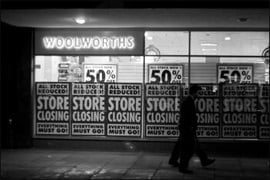
30,000 workers lost their jobs when Woolworths went bankrupt earlier this year. Photo by pilotito on Flickr.
Already in the final
quarter of 2008 the British economy shrank by 5.9%, a bigger
contraction than occurred in 1931. Industrial production has fallen
by more than 10%, with further falls to come. Unemployment stands at
2 million, with 3 million being predicted for next year. The British
Chambers of Commerce are saying it could go even higher, to more than
10% of the workforce. This at a time when the government are
attempting to force another million off incapacity benefit as well as
forcing single mothers back to work.
There has been an
avalanche of redundancies from Woolworths to Nissan. Over the next 3
months, some 320,000 are expected to lose their jobs. 20,000 job
losses hang over the Royal Bank of Scotland. There is a threat to
50,000 offshore oil and gas workers. Some 140,000 shops are due to
close. Already 100,000 building workers are out of work. The car
industry is in acute crisis with a closure threat to GM plants in
Britain, namely Vauxhall in Elmsmere Port and Luton. Hundreds of
thousands face short-term working and wage freezes.
Under capitalism
workers are facing a bleak future. A capitalist was recently
interviewed in the Metro. His name was James B Rogers Jr, a
co-founder with George Soros of the Quantum Fund. When asked if the
car industry should be allowed to fail, he answered: “Yes. Anybody
who fails should be allowed to fail. Capitalism without bankruptcy is
like Christianity without Hell. It doesn’t work otherwise.”
When asked about what
people should do in this crisis, his reply was: “Worry! You need to
hunker down because your government is making plenty of mistakes.
Figure out a way to save yourself. It depends on your skills set. If
you speak Chinese, go to China. Or try farming.” (Metro,
26/1/09)
We can wonder how many
of the 30,000 workers who lost their jobs at Woolworth’s can “save
themselves” or, even better, speak Chinese? It simply demonstrates
how out of touch the bourgeois really are, cocooned in their ivory
towers.
With the collapse of
the housing bubble some 40,000 houses were repossessed last year.
This year the figure is likely to rise to 75,000. Many families find
themselves in negative equity as house prices continue to fall. It
has been estimated that half of all mortgages on the books of
Northern Rock will be in negative equity this year. Thatcher’s idea
of a property-owning democracy has turned into a nightmare. The idea
that it would bind workers to the system and provide social stability
has turned into its opposite.
Fred Goodwin – the ‘scumbag millionaire’ is being targeted by the
press for his £16 million pension. Photo by takomabibelot on Flick.
press for his £16 million pension. Photo by takomabibelot on Flick.
Four out of five
workers are feeling totally stressed at the situation. “Employees
are really feeling the strain from the recession and are finding it
too hard to cope”, says Peter Done of the employment law firm
Peninsula. “The increase in the workload of workers is another
contributing factor with the soaring levels of unemployment we are
experiencing, it is plain to see those still in work are expected to
take on more responsibility.” (The Herald, 23/2/09)
Millions are going
without sleep due to economic worries. A total of 49% are sleeping
badly, according to a poll carried out for the Body Shop. Those aged
between 25 and 34 were the most anxious about making ends meet with
61% of this age group being kept awake by fears over money. When
asked about the details, 32% said they were worried about paying
heating bills, while 26% fretted about food bills. 20% were worried
about their jobs and 15% about their credit card bills. Among women,
43% were worried about their families while 5% of men admitted to
being awake thinking about Gordon Brown!
The working class has
reacted with shock and fear at what is happening. This is mixed with
a large dose of anger. This anger is being directed at the bankers
who have received billion-pound bail-outs. An estimated £1.3
trillion – equal to the entire year’s GDP of Britain – has been
placed at the feet of bankers in Britain. No wonder bankers have been
the villains in Christmas pantomimes and the butt of popular jokes.
The most hated figure nationally is Sir Freddie Goodwin, the ex-chief
executive of the Royal Bank of Scotland. Sir Freddie, after being
relieved from his employment, has netted a £16 million pension pot
which pays out a pension of over £700,000 a year! At the same time
tens of thousands of RBS workers are threatened with the sack. The
press, seeking to cash in on his unpopularity, described him as the
“Scum-bag Millionaire”.
This hatred of bankers
has boiled over into a hatred of capitalism. Even John Prescott has
chimed in against “greed” and “capitalism in the raw”,
despite the fact that he was in a government pushing the free market
idea.
We are in a very
explosive situation in Britain. The scenes at the BMW plant in Cowley
were an example of this when workers were confronted with losing
their jobs. The anger was apparent when the union convener attempted
to justify the sackings. “What the hell is the union for?”
demanded the workers, who received a week’s pay and their P45s. If
there was ever a time when militant unions were needed it was now. In
the Fiat tractor plant in Basildon, when the workers overwhelmingly
rejected a wage freeze and voted for strike action, the union
convener and shop stewards’ committee prevaricated, not giving a
firm lead. This shows how even at rank and file the local leadership,
elected in the past in different conditions, can become a brake on
the growing militancy of the workers instead of articulating their
anger. This is even more the case with the national trade union
leaderships who in several cases have scandalously encouraged the
workers to accept sacrifices at this time.
However, the struggle
at the Lindsey Oil Refinery shows how this anger can break to the
surface in a militant fashion. The fact that this was unofficial
action from below was a marvellous testimony to the workers involved
who said enough was enough. The attempt by the bosses to undercut
terms and conditions provoked these workers to take action.
The ruling class are worried by rising militancy and are attempting
to divide workers by putting forward the reactionary slogan ‘british
jobs for british workers’. The union bureaucracy, far from attempting
to combat this, are happily posing with Daily Star’s posters.
to divide workers by putting forward the reactionary slogan ‘british
jobs for british workers’. The union bureaucracy, far from attempting
to combat this, are happily posing with Daily Star’s posters.
The ruling class were
alarmed by this dispute. The government feared power cuts, but it
also feared that this example of militant struggle could affect other
layers of the working class, who could take up strike action. As a
result a deliberate attempt was launched to divide the strikers by
advancing the demand “British jobs for British workers”. At every
occasion the press and TV attempted to divert attention away from the
real causes of the dispute: for all workers to come under the “blue
book”, a defence of national agreements on terms and conditions.
The scenes at Lindsey
were reminiscent of the struggles in the 1970s and also the miners’
strike. Workers’ solidarity and workers’ democracy through the mass
meetings characterised the entire movement. The mass picketing
revealed the underlying strength of the struggle.
Given the level of
anger in the working class the question of factory occupations can
also assume great importance in the next period. Many years ago a
factory occupation at Timex in Dundee was an example to all workers.
Today, workers in a packaging plant in Dundee, who were threatened
with the sack, again gave an example by occupying their workplace. In
the current climate this could become generalised as workers realise
that wage cuts and short-time working are no solution in this
capitalist crisis. The question of nationalisation will also find an
echo amongst workers fighting redundancies.
The stormy period
opening up in Britain was hinted at in the recent police report of a
new summer of discontent. The report explained that given the numbers
losing their jobs and homes, anger would spill over into violent
street protests and riots. It compared the situation to what happened
in 1981 with the Brixton/Toxteth riots, as well as to the stormy
scenes during the miners’ strike.
The Labour government
appears to be heading for the electoral rocks. After being buoyed up
by the world boom over the last 12 years, the government is now
facing a dire economic situation. The capitalists are keen for Brown
to clear up the economic mess and shoulder the blame for the crisis.
In the press, Brown went from Zero to Hero as he strutted about the
international arena. But that has very quickly come to an end.
The Labour government
has pumped in billions to bail out the banking system, including the
nationalisation of Northern Rock. It is desperate to rescue the
capitalist system, throwing some £20 billion into the economy in the
November Budget. They have forced the Bank of England to cut interest
rates to an historic low and increased government debt to levels not
seen since World War Two. Despite this, the crisis continues to
deepen. Unemployment is rising and tax revenues are falling.
According to Will Hutton, the public debt could grow to 250% of
national income – or £3,750bn – in the coming months, an
astronomical level. In 1976, the government was forced to turn to the
IMF for a loan with lower levels of debt than this. That situation
could return again.
According to the
Institute of Fiscal Studies, in order to restore credibility to the
public finances, public expenditure will need to be cut by an extra
£20 billion EVERY YEAR until the end of the next parliament. These
are truly draconian measures! Even with these cuts, public sector
debt may not return to pre-crisis levels for more than 20 years.
Public spending cuts and tax rises would remain until the 2030s. This
makes the £8 billion cuts of the Callaghan government look like
chicken feed.
In other words, the
British working class are facing 20 years of austerity, not seen
since the inter-war period. Whoever wins the next general election –
whether it be Labour or Tory – it will be a government of crisis.
Although the most
likely result is a Tory government, given the opinion poll leads of
the Tories of between 10% and 20%, there is little enthusiasm for
Cameron’s policies. A recent poll asked which party was more suited
to deal with the crisis. The majority replied “Neither”. A COMRES
survey revealed that 83% disagreed that the Tories has the right
ideas to deal with the situation. Even the Financial Times
sharply criticised the Tories for not coming up with policies that
will deal with