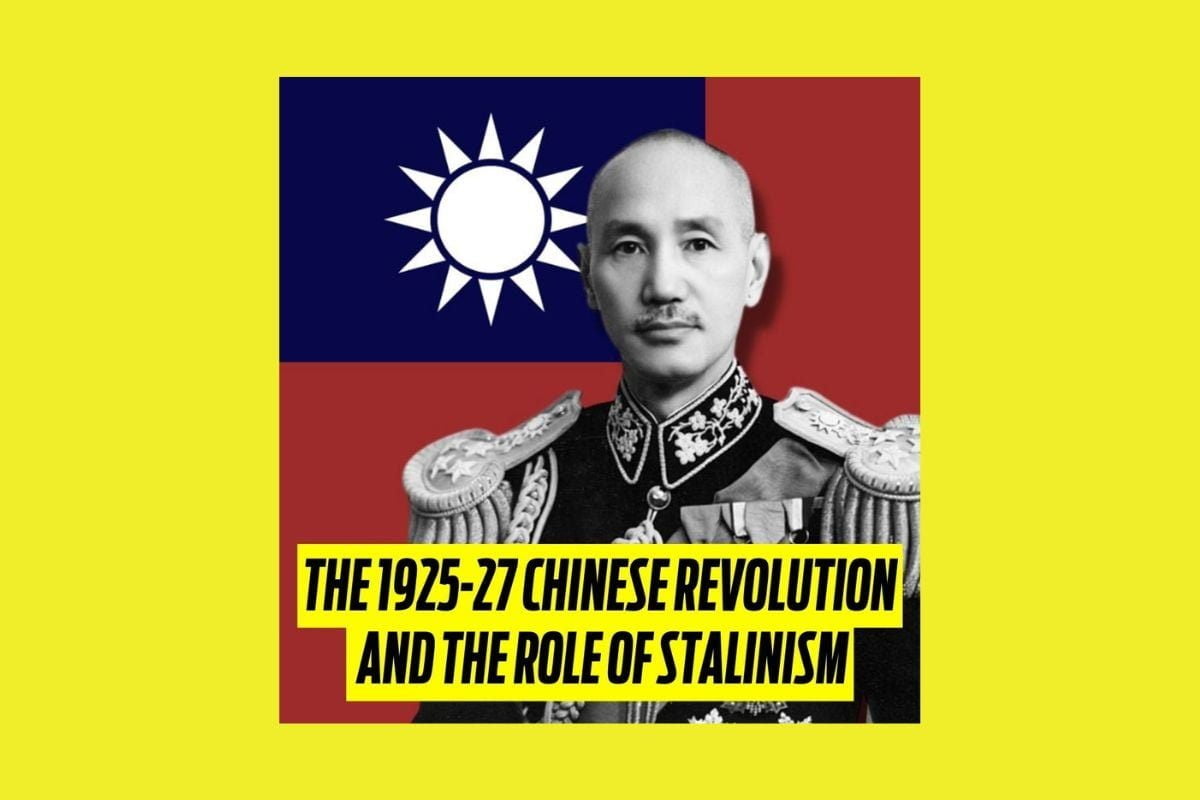
On March
20th, 1926, another event similar to the assassination of Liao Zhongkai
took place. It laid the basis for the violent coup of Chiang Kai-shek in
Guangzhou, when his mask of democratic revolution slipped. The uneasy
tension between the Guomindang right wing and the CCP comrades inside
the Guomindang broke out into the open.
On March
20th, 1926, another event similar to the assassination of Liao Zhongkai
took place. It laid the basis for the violent coup of Chiang Kai-shek in
Guangzhou, when his mask of democratic revolution slipped. The uneasy
tension between the Guomindang right wing and the CCP comrades inside
the Guomindang broke out into the open.
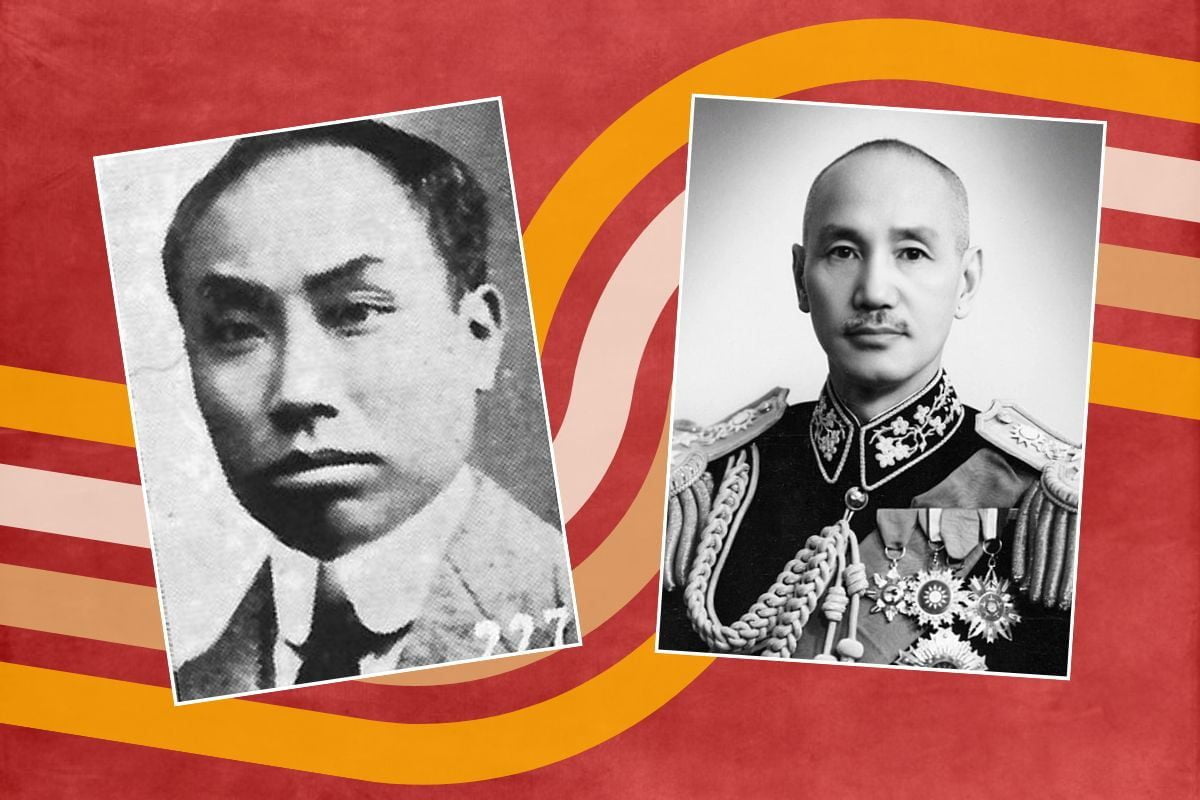
Chiang Kai-shek’s First Coup
A
CCP member, Li Zhilong, who had been promoted to the leading position
in the Navy Department of the new government, was thought by Chiang
Kai-shek to be planning to capture him and send him on a ship as far
away as Vladivostok in response to rumours of Chiang’s attempt to
replace Li Zhilong with his own stooge. If this had happened it would
have meant that a CCP member, breaking ranks with the intolerable line
of the leadership, would have dealt a powerful blow to the right wing,
as Chiang Kai-shek would then have been completely out of action.
If
it is true that Li Zhilong planned this abduction, it was the first of
three crucial moments in which the CCP had a favourable military
opportunity to move decisively against Chiang Kai-shek as a
counterrevolutionary. The other two opportunities both involved the
radicalised Guomindang army commander Xue Yue, who in 1927 and again in
1936 offered to arrest Chiang Kai-shek for the CCP, which criminally
rejected his proposal on both occasions.
After
having foiled this supposed plot by arresting Li, Chiang Kai-shek, like
a true military man and bonapartist, seized the initiative and took
power in a coup in which the Guomindang leftwing as well as the CCP were
openly defeated. He used the cover of darkness to secure all positions
of power over the mass movement with his military forces, so that by the
next morning his power was already cemented, leading to utter confusion
and demoralisation both amongst the left Guomindang and the CCP.
The
reactionary, counterrevolutionary character of this plot was expressed
in its strategy – hundreds of communists were arrested, the strike
committee headquarters were raided, left Guomindang political and
military figures were also arrested, and all Soviet advisors were now
under house arrest. And yet Stalin still refused to draw the
conclusions, and he hid news of this embarrassment for his strategy from
the whole Comintern for a year, sowing massive confusion among Chinese
communists who did not know that ‘their man’ in the Guomindang had just
organised a counterrevolutionary coup. This act alone proves that
responsibility for the defeat of the CCP in 1925-7 lies in Moscow. And
still after this Borodin and the Comintern accepted Chiang’s ridiculous
and pathetic ‘apology’ for this ‘mistaken action’, gave him advice and
continued to supply him with arms!
The ‘left’ Guomindang, under
Wang Jinwei’s leadership, lost no time in fulfilling their role as
little more than left-phraseologists puffed up only by the magnificent
mass movement that lay beneath them. This movement having suffered a
temporary setback, Wang Jingwei and the other Guomindang leaders not in
Chiang’s camp knew not what to do, and so literally fled the scene,
leaving Chiang’s authority utterly unchallenged, like an omen of
Hitler’s rise to power seven years later, to which the communists and
social democrats immediately capitulated without a fight. The Guomindang
Executive Committee merely asked that Chiang ‘recognise his mistake’.
Considering his coup’s extraordinary success, that would seem an
unlikely conclusion for Chiang to draw.
The disorientation that
followed in the ranks of the CCP is testament to the necessity of
developing a correct Marxist, materialist perspective, through a
democratic discussion, as to future developments in the class struggle.
After all, revolutionary parties should be preparing for nothing other
than dramatic changes in the situation such as this.
Two months
after Chiang’s coup was established, the meeting of the Guomindang
Central Executive Committee approved resolutions subordinating the
entirety of the Guangzhou regime to Chiang Kai-shek’s personal power.
Chiang himself moved resolutions aimed at exploiting the CCP’s policy of
subservience – now all CCP members had to ‘not entertain any doubt on
or criticise Sun Yat Sen or his principles’. A list of all Communists
within the Guomindang was to be given to Chiang (and on Borodin’s orders
the CCP speedily supplied him with this list), Communists were to be
bureaucratically restricted in the number of posts they could hold, and a
‘joint party committee’ was to be set up to review all instructions
from the CCP Central Committee! To voluntarily hand over your membership
list to a newly established military dictator is a blunder of
extraordinary proportions.
These alarming developments put to the
test the relationship of the CCP to the Comintern, which constantly
acted over the heads of the Chinese communists to secure what it wanted.
Isaacs quotes Tang Liang Li as reporting that following this meeting in
which Chiang openly attacked the CCP “Chiang’s relations with Borodin
became more cordial than ever”. No doubt Borodin felt that he was having
a decisive influence over Chiang Kai-shek, just like all yes-men
entertain delusions of grandeur for telling their boss only what they
want to hear.
We have, however, been a little one sided so far in
neglecting the internal opposition of the CCP to Borodin’s (Stalin’s)
policies. It is hardly surprising that there would be opposition to all
this, given the CCP’s initial opposition to the Guomindang and its
Bolshevik foundation, and given that Borodin, according to Chen Duxiu,
said to the Chinese communists “the Communists should do coolie service
for the Guomindang!”
Attempts to Break with the Guomindang
The
CCP, formed as a party of revolutionary struggle against imperialism
and capitalism and for a classless society, could hardly accept a policy
of carrying out coolie service! For more than a year leading up to this
leading members and bodies of the CCP had been trying to break with the
Guomindang, and were halted by the Comintern. In August 1924, shortly
before he died, Sun Yat Sen ordered that the Guomindang Central
Committee place a review over all Comintern orders to the CCP. According
to Peng Shuzhe this was sufficient to set the alarm bells ringing,
“Tsai
Ho-sen told me about Sun’s motion regarding Guomindang review of all
Comintern resolutions and orders to the CCP and asked what I thought
about it. “Has the Central Committee accepted this demand?” I asked.
Tsai replied “they are thinking it over now.” “The Central Committee
must refuse Sun’s demand,” I said strongly, “otherwise, our party will
become a mere appendage to the Guomindang.” Tsai talked this over with
Chen Duxiu, and they sent a telegram to Qu Qiubai ordering him to refuse
Sun’s demand.”
He continues,
“After this, I presented three
formal resolutions to the Central Committee: (1) we should assume a
critical attitude toward the policies and activities of the Guomindang;
(2) we must renew our local party organisations everywhere…(3) we
should establish a Labour Movement Committee in order to plan for and
lead the national workers’ movement. The Central Committee adopted these
resolutions.” (Peng Shuzhi, Introduction to Leon Trotsky on China)
This
was followed up with a resolution which passed the CCP’s Fourth
National Congress in January 1925, which called “for proletarian
leadership of the revolution, and plans were made to rebuild and develop
the workers’ movement of the entire nation…This congress marked the
return of the CCP to Bolshevism” (Ibid). According to Gregor Benton,
“At
the CCP’s Third Congress in June 1923, there was almost a majority for
an amendment calling for an independent workers’ party, but Sneevliet
fought back and won the vote. In 1924, Chen Duxiu, Cai Hesen, and Mao
Zedong actually advocated a break with the Guomindang and wrote to all
committees and cells preparing them to vote for one. But Borodin and
Voitinsky, representing the Comintern, were against the idea, so again
nothing came of it…In October 1925, after the right wing of the
Guomindang had begun to oppose the Communists’ presence in the
Guomindang, Chen Duxiu is said to have proposed that “we should prepare
ourselves immediately to withdraw from the Guomindang and become
independent,” but once again his proposal was defeated. In July 1926
[i.e. a few months after Chaing’s coup] he called one more time for
withdrawal; again the Comintern rejected him.” (Benton, China’s Urban
Revolutionaries)
This burgeoning opposition in China, mirroring
the development of the Left-Opposition in Russia, explains why the
Comintern had to keep the fact of Chiang Kai-shek’s coup hidden from the
Chinese Communists outside of Guangzhou as well as from the
International. It was even necessary for Borodin to undermine the
democratic rights of the CCP by demanding that “the question of leaving
the Guomindang must be agreed upon by the left wing of the Guomindang”
(quoted by Peng Shuzhi, op cit.). This statement is a tacit admission
that the Comintern wished to dissolve the CCP, that it was by now really
only a bargaining chip in their relations with the Chinese bourgeoisie.
So desperate was Stalin for the CCP not to break with the ‘national
bourgeoisie’ that he was chasing after it even after the bourgeoisie
itself had broken with the CCP! The imposition of the Comintern on the
CCP in these months laid the foundations for the development of a
Trotskyist left opposition within the CCP.
Now that Chiang’s power
was cemented and the possibility of any communist opposition, which he
clearly feared, was dealt with, he began once again to show a left face
and to organise the ‘Northern Expedition’, a war against the militarist
warlords that controlled the rest of the country.
What should have
been the attitude of the communists to this expedition? Despite Chiang
Kai-shek’s reactionary, counterrevolutionary role in the Chinese
revolution, which was by now an established fact, the content of this
war under his leadership was progressive or even revolutionary, as
Trotsky correctly argued at the time,
“China is an oppressed
semicolonial country. The development of the productive forces of China,
which is proceeding in capitalist forms, demands the shaking off of the
imperialist yoke. The war of China for its national independence [i.e.
the Northern Expedition] is a progressive war, because it flows from the
necessities of the economic and cultural development of China itself,
as well as because it facilitates the development of the revolution of
the British proletariat and that of the whole world proletariat.
“But
this by no means signifies that the imperialist yoke is a mechanical
one, subjugating ‘all’ the classes of China in the ‘same’ way. The
powerful role of foreign capital in the life of China has caused very
strong sections of the Chinese bourgeoisie, the bureaucracy, and the
military to join their destiny with that of imperialism” (Trotsky,
Problems of the Chinese Revolution)
But since the so-called
national bourgeoisie and the compradore and imperialist bourgeoisie will
always put aside their differences for the sake of the common aim of
defeating the workers movement, the Guomindang’s leadership of the
Northern Expedition, whilst not altering the overall progressive
character of that war, acted to limit the progressive outcome of the
Northern Expedition’s victory by using it only as credit with which to
buy a better deal with the imperialists to continue exploiting Chinese
workers and peasants,
“The bourgeoisie participated in the
national war as an internal brake, looking upon the worker and peasant
masses with growing hostility and becoming ever readier to conclude a
compromise with imperialism.
“Installed within the Guomindang and
its leadership, the national bourgeoisie has been essentially an
instrument of the compradors and imperialism. It can remain in the camp
of the national war only because of the weakness of the worker and
peasant masses…the lack of independence of the Chinese Communist
Party, and the docility of the Guomindang in the hands of the
bourgeoisie.” (Ibid)
That the bourgeoisie could only support and
lead the Northern Expedition on the basis of the weakness of any
communist opposition is proven by the fact that Chiang Kai-shek would
not launch it without Borodin and the Comintern’s ‘advice’ and
‘support’. Of course Chiang was happy to show a left face in words in
order to secure CCP backing and material aid from the Soviet Union,
which came no-strings-attached. Undoubtedly Chiang’s pleas for support
filled Moscow with joy as proof that they had won an ally against the
West. This was true only in the negative sense, i.e. that Chiang
Kai-shek and the bourgeoisie were too weak to rule without the
unquestioning aid of the Comintern, and without shackling in advance the
workers’ leaders. This is proof of the potential power of the Comintern
and CCP. But that one has voluntarily submitted to one’s own
imprisonment is not a manifestation of actual strength but of fatal and
foolish weakness.
The Comintern’s backing of the Northern
Expedition coincided with the implementation of martial law and the
“forbidding of all labour disturbances for the duration of the Northern
Expedition” which apparently amounted to “treason against the
Guomindang.” Workers in Guangzhou, against the CCP leadership (which
had of course submitted to and authorised the martial law), defended
themselves against the shutting down of their unions, for which more
than fifty workers sacrificed their lives.
Negotiations with the Imperialists and the Beginning of the Northern Expedition
Proof
that absolute control over the Northern Expedition was necessary not
for its unconditional triumph but to make deals with the imperialists in
freedom, using the war as a bargaining chip, arrived as early as the
war itself begun,
few days after the adjournment of the May plenary session of the
Central Executive Committee of the Guomindang [i.e. the one that
initiated the attack on the CCP following Chiang’s coup], the Guangzhou
government officially approached Hong Kong [the British] to reopen
negotiations. The British readily agreed. The delegates met in July [by
now the Northern Expedition had begun].” (Isaacs, op cit.)
The
negotiations led by the Guomindang, ostensibly to achieve the demands of
the still striking Guangzhou workers for British withdrawal from Hong
Kong, resulted only in the removal of some of the British gunboats
outside Guangzhou harbour, which incidentally had by now already been
used to break up the picket lines on the docks. So under the terms of
Chiang’s martial law, which ended the strike on the pretext that the
Guomindang could thereby negotiate better with imperialism and wage a
war against the Warlords, none of the demands of the revolutionary
movement were met. The British could not only stay in Hong Kong, but had
now established friendly ‘connections’ with Chiang Kai-shek’s regime.
The ending of the strike wave also enabled the routing of all other
strikes and workers’ organisations in general, and with this came the
loss of the material gains workers in the area had made.
If it was
an error to give Chiang unconditional backing for his adventure against
the northern Warlords, it would equally have been a mistake to oppose
outright the Northern Expedition simply because it was led by Chiang
Kai-shek and the Guomindang. Marxists must always proceed from what is,
not what we would like things to be, in order that we be able to make
things how we would like them to be. And it was a fact both that the war
was objectively progressive, aimed as it was against the
feudal/compradore warlords and imperialists, and at the same time that
it was led by counterrevolutionaries. In such situations revolutionaries
must participate in the struggle side by side with the masses also
participating in it with the aim of winning the masses away from
bourgeois leadership to a revolutionary proletarian one. That millions
of workers and peasants voluntarily fought in the war against the
Warlords is a sign both of the objectively progressive character of the
war and that an opportunity existed for the CCP to win leadership of the
movement away from Chiang Kai-shek.
What strategy then should the
CCP have pursued? As we pointed out earlier, there is a close
historical parallel between the relationship of the Russian Social
Revolutionaries to the Russian Revolution and the Bolsheviks, and the
Guomindang’s relationship to the Chinese Revolution and the CCP. Just as
in the turmoil of the Russian Revolution the Social Revolutionaries
split into a left and a right-wing, the former representing the more
radicalised poorer peasants and urban petty bourgeoisie, the latter more
the Kulaks, so the Guomindang had its right-wing, headed by Chiang
Kai-shek and based around the need to wipe out the CCP to conclude a
more favourable deal for the big bourgeoisie with imperialism, and its
left-wing, headed by Wang Jingwei and more favourable to working with
(or using the support of) the CCP.
Chiang’s coup had ousted Wang
Jingwei from leadership of the Guomindang following Sun Yat Sen’s death,
and for that reason the leftwing which was coalescing around his
leadership opposed the coup in the phraseology of bourgeois democracy.
As we have seen without the CCP’s opposition to this coup this wing was
impotent.
We have also seen how Chiang Kai-shek did not feel
confident enough to embark on the Northern Expedition without the
material and political support of the CCP and Soviet Union. Therefore
the Comintern and CCP should have publicly backed the progressive
Northern Expedition as an independent party. Had Chiang Kai-shek then
reneged on this pledge to struggle against Warlordism and imperialism,
lacking the required acquiescence of the Communists, he would have been
exposed as a faker seeking only to use the communist movement.
At
this point an open struggle would have ensued between Chiang and the
CCP, the latter calling for a revolutionary war against imperialism and
Warlordism and able to count on the newly awakened mass support of the
working class in Shanghai and Guangzhuo, as well as the resources of the
Soviet Union. In order to win over the peasantry and urban petty
bourgeoisie to their banner, the CCP could have proposed a bloc or
united front with the left Guomindang, exploiting the open split in that
party, in order to overthrow Chiang’s dictatorship and initiate a
struggle against imperialism. The terms of this united front would have
to be agrarian reform to give land to the peasants. It is true the left
Guomindang would eventually have betrayed such a united front, just as
the left Social Revolutionaries did, but only after the CCP had publicly
come out in favour of land reform and against the openly
pro-imperialist Chiang Kai-shek.
The Northern Expedition drove up
through China from the nationalist base in the far South along two main
fronts, the first (the ‘Western Route Northern Expeditionary Forces’)
headed toward Wuhan (a conglomeration of three cities – Hankou, Wuchang
and Hanyang) on the Yangzee River in Hubei Province, Eastern Central
China), the other, led by Chiang Kai-shek (the ‘Central Route Northern
Expeditionary Forces’), headed toward Nanchang in Jiangxi Province,
which is slightly to the South East of Wuhan. Both offensives achieved
relatively rapid success, but the former, more closely associated with
the Guomindang left wing and the mass movement, was stunningly
successful in defeating the Warlords, taking the key city of Wuhan,
1,000km from Guangzhou, three months after setting out, whereas the
latter, associated with Chiang Kai-shek, was less so, taking an
additional month to reach the nearer city of Nanchang and sacrificing
more lives on the way.
The explanation for this lies in the class
contradictions of Chinese society. The armies of the Northern Expedition
enjoyed the active support of the masses of China, who rose up in
anticipation of the coming armies, which they saw as liberators from
landlord oppression. They sabotaged the defence of the militarists in
countless ways – mini-uprisings of unorganised peasants took strategic
villages on behalf of the armies, peasants acted as a sort of vast
informal network of spies for the expedition, and workers struck in key
industries in Wuhan and other cities. To this must be added the
demoralisation in the ranks of the Warlord armies, swathes of whom must
have had no desire to defend a rotten regime.
In other words the
peasantry and new sections of the working class were following the
example of the Guangzhou and Shanghai workers and taking the revolution
into their own hands. Peasants were organising their own land reform and
organising on a mass scale independently of the Guomindang (not only
did new trade unions flourish in Hubei, but according to Isaacs 2m
joined new peasant associations in neighbouring Hunan province). All of
this confirms the Marxist thesis that the peasantry can play a decisive
role in the revolution, and will always look to whichever urban class
offers them a way out, which in this case was the revolutionary workers.
Furthermore,
although clearly the workers and peasants here were inspired by the
Northern Expedition and so looking to the Guomindang as the leadership
of that movement, ignorant of its recent role in crushing the movement
in Guangzhou, they were at the same time organising independently of the
Guomindang and along class lines, in direct contradiction with that
bourgeois party’s class basis and political line for the revolution.
This contradiction between the masses and the Guomindang would shortly
lead to further coups from both the right and left Guomindang against
the revolution.
It was clearly the class content of the
revolutionary overturn in Guangzhou, organised as it was by the CCP’s
trade unions, that directly inspired these peasants and workers further
north. A class basis existed then for the CCP to expand its influence in
this new opening up of the struggle, and indeed it was one seized by
the party’s rank and file,
“[the CCP] organised workers and
peasants into all types of commando units to handle reconnaissance,
spying and scouting. These units were also responsible for sabotage of
communications behind enemy lines (railroads, electrical lines, ships,
etc.), and for collection of abandoned weapons when the enemy retreated.
Among the official positions in the National Revolutionary Army, there
were dozens of CCP members acting as company commanders, battalion
commanders, and regimental commanders…All of these quick and
surprising victories were the direct result of the active aid rendered
by the worker and peasant masses which had been mobilised by members of
the CCP.” (Peng Shuzhi, op cit.)
The objective class character of
the revolution was asserting itself in spite of its leadership. We can
see very clearly the basis for the CCP to take over leadership of the
revolution had it set itself this task. Its name, its founding
objectives, its thousands of rank and file members, directly embroiled
in the struggle alongside the masses, often leading them in military
roles, its link to the victorious Russian Revolution and the access to
arms (in addition to those already under its control through commanding
Northern Expedition troops) that this enabled, its leading role in the
unions all speak of the enormously favourable conditions for a CCP led
revolution against the Guomindang provided it openly supported land
reform and the social revolution.
It was precisely fear of the
revolutionary independence of the masses and the role of the CCP that
lay behind Chiang Kai-shek’s slower and bloodier conquest of Nanchang.
Naturally there was less CCP influence in his ranks following his
suppression of the CCP in Guangzhou. It was this continued policy of the
suppression of the CCP and the mass movement which weakened his
campaign. “Chiang had restricted the activities of the propagandists and
had along the line of march already adopted repressive measures against
the mass movement. This enabled Sun Chuanfang, militarist overlord of
the five eastern provinces, to put up stiffer resistance” (Isaacs, op
cit.).
The Character of the ‘Left’ Guomindang
The physical
divergence of the two tendencies in the Guomindang, the left (or rather
the vacillating) taking Wuhan and the right (or decisive) taking
Nanchang, cemented the open split between them. We already know the
character of the right-wing led by Chiang Kai-shek, thanks to his coup
against the CCP in Guangzhou. This tendency was the clear Bonapartist
one, that is to say it represented the tendency to raise the repressive
state power above society in order to crush the revolution. But what was
the character of this new ‘left’ Guomindang government in Wuhan led by
Wang Jingwei?
It was undoubtedly a weak bourgeois regime, whose
fear of the movement of the masses led it to pose as its friend rather
than to crush it. It had not yet abandoned the petty bourgeois utopian
Sun Yat Senist ideology of national harmony across the classes. But the
leaders of this national harmony of course had to be the ‘natural’
leaders of the nation, that is the men of property, for to put the
workers movement in the lead in their stead would mean to expropriate
this property, to put it in the hands of the workers, and that already
means an end to intra-class harmony. Hence the opposition from these
leaders, and the Comintern in their wake, toward any independence of the
workers, to strikes and to land reform, despite the fact that the
strikes of the workers against the capitalists, and the land seizures by
the peasants, were precisely what had brought the ‘left’ Guomindang to
power in Wuhan.
Indeed a condition for work in the Guomindang laid
down by the Comintern was that the CCP must only support land reform
for land pertaining to militarist landlords. But if a party such as the
Guomindang has a policy of not expropriating the land of any landlords
that support it, then naturally all landlords will proclaim that they
support the Guomindang as soon as it proves stronger than the Warlord
regime. In this way an entire class and property system evaded the CCP.
A
Marxist leadership bases itself on a materialist analysis of the
fundamental antagonisms between the classes in order to understand which
way the class struggle will develop. It would understand that the
enormous proliferation of revolutionary, political strikes and land
seizures in carrying out the revolution on the one hand, and the
existence of a recent military coup against these tendencies on the
other, would signify an extreme intensification of class struggle such
that a harmonious class compromise is ruled out.
In these
conditions it was an impossibility for the Guomindang to maintain a
passive policy of class collaboration and democracy for any length of
time. Therefore a Marxist party would gear all its efforts toward
preparing itself and the masses for an open struggle against the
bourgeois party. At every step the CCP should have “worked inside the
Guomindang and patiently drawn the workers and peasants over to their
side…by supporting every forward step of the Guomindang, by
relentlessly unmasking every vacillation, every step backward, and by
creating a real revolutionary foundation for a bloc with the Guomindang
in the form of workers’, peasants’, and soldiers’ soviets” (Trotsky, op
cit.). The CCP should have exploited the Guomindang’s attacks on the
mass movement by acting as the latter’s chief defender.
But as we
have explained, the Comintern had ceased to have a Marxist leadership
which approached everything from the standpoint of the class struggle,
and instead imagined it could order the class struggle out of existence
in order to secure its coveted alliance with the Guomindang. Because the
party was tied to the Guomindang above all else, it could not
independently stand for land reform etc., and so could not win the
masses who strove for land reform to its banner, fatally weakening
itself and the revolution come the time when even the ‘left’ Guomindang
would openly attack the revolution.
Voroshilov, a Comintern
advisor in China, complained that “the peasant revolution might have
interfered with the Northern Expedition of the generals”, failing to
notice that it was precisely the peasant revolution which secured the
revolution for the generals. As Trotsky correctly predicted, these
‘left’ Guomindang generals and political leaders, whose policy was to
use the mass movement to wring concessions from and make a deal with
imperialism, would have to turn sharply to the right and attack that
mass movement once it had served its purpose of bringing them to power,
just as Chiang had. This would be necessary in order to better negotiate
access to foreign capital and weaponry rather than incur the embargo
that the imperialists threatened.
Chiang Approaches Shanghai
It
was Chiang Kai-shek that took the initiative in the struggle to
consolidate power in the Guomindang following the split with Wang
Jingwei by driving on with his ‘Central Route Northern Expeditionary
Forces’ to Shanghai, which was slightly closer to his base of Nanchang
than Wang Jingwei in Wuhan. Of course capturing Shanghai, which was not
only a key strategic city in general, but also the epicentre of
imperialist/compradore bourgeoisie relations, would practically cement
Chiang Kai-shek’s dominance of the Guomindang.
Once again the
objectively progressive character of the war against the Warlords was
expressed in an unprecedented development of the labour movement in
Shanghai as Chiang’s forces approached. Again, this shows both the
support in the populace for the Guomindang (or at least support for what
it was doing), but also the socially deeper support for the CCP. For it
was the General Labour Union (GLU), founded and led by CCP comrades,
which organised and coordinated the immense upturn in strike activity in
the early months of 1927. According to Isaacs more than 350,000 heeded
the GLU’s call for a general strike on 19th February 1927
with the intention of weakening the existing regime (Shanghai was under
the control of the same Warlord, Sun Chuanfang, as Nanchang). Yes, these
workers (for the time being at least) supported Chiang Kai-shek’s
leadership – but only under the instructions of the leadership of the
leaders of their own class, the CCP, to which they were far closer.
As
we shall shortly see, on this basis the working class could have taken
this key city even before Chiang Kai-shek arrived and with far less
violence, so all embracing was the popularity of the revolution and the
CCP amongst the Shanghainese working class. Under a correct strategy and
with military aid from the Comintern there is no doubt that the workers
of Shanghai could have successfully opposed Chiang Kai-shek, exploiting
the splits and resulting weaknesses in the Guomindang, leaving Chiang
adrift in the Zhejiang countryside as an historical footnote.
Instead
thanks to the erroneous policy of subservience to the Guomindang, more
nonsensical than ever now that the party was split and without
leadership, the CCP was obliged to ingest and reproduce all the
confusion, weakness and vacillation of the leaderless Guomindang. There
was no clear policy regarding Chiang Kai-shek’s role just when the
comrades in Shanghai needed it the most. Whenever the CCP was in the
proximity of Chiang, they denied the existence of the split in the
party, rallying the working class around him. They were incapable of
taking even tentative steps beyond the confines of his leadership. But
in Wuhan they were emboldened by the established fact of Chiang’s
betrayal and openly attacked him. But just like the ‘left’ Guomindang
they were incapable of offering any programme to take the revolution
forwards against Chiang Kai-shek, once again terrified of taking an
independent course.
By now of course the CCP leaders had been
beaten into a habit of simply following Comintern or Guomindang orders.
The spirit of independence had been suffocated. And yet at the same time
the gravity of the revolution and its class dynamics compelled them to
do something with the labour movement, hence the confused character of
this general strike in Shanghai which despite its powerful social force
aimed at nothing more than welcoming a would-be military dictator,
“the
strike was effective but its leadership had no goals of its own. The
slogans announced by the Communists were confined to: “Support the
Northern Expeditionary Army!” “Overthrow Sun Chuanfang!” “Hail Chiang
Kai-shek!” The Central Committee of the Communist Party simply waited on
events and orders from outside” (Isaacs, op cit.)
Once a general
strike has been organised and is taking place, there is no going back.
The strike movement must boldly go forwards from one conquest to
another, with a clear strategy and set of demands so that all
participants understand what they are fighting for, which will
strengthen their resolve. But calling out hundreds of thousands of
workers on no independent programme, simply to welcome someone else, is
extremely dangerous. It is akin to ordering an army into the no man’s
land between trenches, and leaving them there with nothing to do.
The
inability for the workers of Shanghai to use their strike to conquer
any positions for themselves gave the ruling class the confidence to
quickly counter-attack. And the lack of any strategy comprehended by the
workers meant that, faced with the counter-attack, those workers had no
means with which to reorient themselves and fight back. Disarray
ensued. Indeed there is evidence that Chiang Kai-shek colluded with the
Warlord regime in Shanghai, deliberately delaying his arrival in the
city so that the police could slaughter the stranded workers. He
certainly had every incentive to do this since it had the dual benefit
of weakening the communists and keeping his hands clean. The fact that
General Li, who commanded the counter-attack, was later made the
commander of the 8th Nationalist Army under Chiang Kai-shek shows that Chiang was grateful for his actions whether or not he colluded in them.
Isaacs
quotes the New York Herald Tribune in the midst of the general strike
as it describes the brutality of the ruling class’ sudden
counter-attack,
“After the heads of the victims were severed by
swordsmen, they were displayed on top of poles or placed upon platters
and carried through the streets…The executioners bearing broadswords
and accompanied by a squad of soldiers, marched their victims to a
prominent corner where the strike leaders were forced to bend over while
their heads were cut off. Thousands fled in horror when the heads were
stuck on sharp-pointed bamboo poles and were hoisted aloft and carried
to the scene of the next execution.”
The tragedy is that with a
correct leadership the millions of Shanghai could have been mobilised
around the hundreds of thousands of striking workers and simply
overwhelmed the executioners.
More than a month passed before
Chiang Kai-shek entered the city, and in the meantime the workers once
again took the initiative against the Warlord regime. The CCP led GLU
called another general strike and on 21st March up to 800,000
came out, utterly paralysing the city and regime. It would seem that,
despite the absence of national and international leadership, the local
working class and CCP comrades had learnt from the harrowing experience
one month previously,
“This time there were carefully laid plans
for an insurrection based upon a workers’ militia composed of 5,000
picked and trained men, broken up into squads of twenty and thirty.
According to one account, their total initial supply of arms consisted
of 150 Mauser pistols. That meant less than one to a squad. The attack
on the police and Shandong soldiery was made in the beginning only with
clubs, axes, and knives.”
And yet through sheer numbers and determination this proved sufficient,
“The
fight for control of police stations and local military posts was won
by the workers by nightfall in all sections except Chapei. Many soldiers
and policemen tore off their uniforms and surrendered arms and
ammunition. Weapons were taken everywhere and by evening the attacking
forces were comparatively well supplied…Soldiers and police caught in
flight were disarmed. Many of them joined the pickets in setting up a
Provisional Workers’ Bureau of Public Safety and in taking over the
municipal offices of the whole district.” (Ibid)
So much for
Chiang Kai-shek the all powerful and ‘gallant commander of the
Cantonese’ to whom all communists must bow. In the end, the working
class took over this great city in a manner far more comprehensive than
any simple military occupation could ever manage, showing that in war
the class struggle must not be postponed till after a military victory
but used to ensure military victory. The organised Shanghainese working
class was now in possession of that most precious prize of the class
struggle – the armed bodies of men that make up the state. They had no
reason to surrender their arms to anyone since there can be no social
force more formidable than the armed, united and fully conscious working
class.