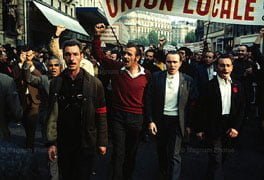

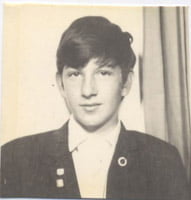
It was April 1968. I was sixteen years of age at the time. For
the previous two years, I had been an active member of the Swansea Labour Party
Young Socialists and a supporter of the Militant Tendency, after hearing Ted
Grant speak about the Russian Revolution.
In 1968 things had reached a very low ebb in the Labour
Party. Prime Minister Harold Wilson had succeeded in demoralising Labour
supporters after introducing a series of counter-reforms. The euphoria of the
general election of 1966, where Labour had won a landside victory, had
evaporated. As you can see, there are certain parallels with today. Many
radicalised young people had turned away from Labour towards the anti-war
movement, opposing the American intervention in Vietnam. It was part of the
general radicalisation that was taking place amongst students internationally,
reflecting itself in demonstrations and campus occupations.
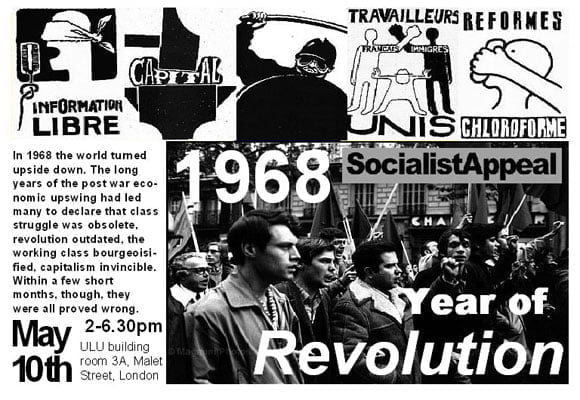
However, revolutionary events in France were about to
transform everything in a big way. It also had a profound effect in Britain. Although
these events took place 40 years ago, I can still remember them clearly and the
enormous impact they made on me. The events of France in 1968 left an indelible
impression on the consciousness of all who lived through them.
 |
| Rob Sewell, 1968 |
At school I had studied ‘O’ Level French and had been
corresponding with a pen friend living in Paris, who I had stayed with the
previous summer. Given the approaching Easter holidays I persuaded a school
mate to come and explore Paris for a couple of weeks during the school break. I
remember we arrived very late in to London and made our way to Kings Cross Station
where we were forced to stay the night. The experience was quite scary as we
were carrying enough French Francs to last us two weeks and Kings Cross was a
very seedy area. In the early morning, to our relief, we headed off to Victoria
to catch a boat train to Paris. When we finally arrived we managed to find a
scruffy boarding house near the Gare du Nord. After seeing most of the tourist sights
of Paris in the first week my friend decided to return home early, but I
decided to stay on and seek out a French friend Roland Ede who I had stayed
with the year before.
His mother and brother had gone away on holiday and he had
the flat all to himself. I could stay for as long as I liked. He took me to
visit various places, including the student cafes. There was always some new
experience in Paris. I remember he cooked a meal from horse meat, the first
time I had ever eaten the stuff, but it wasn’t bad at all.
Then one day he asked me if I was interested in attending a
student demonstration in the centre of Paris. Students were demonstrating
against the archaic education system. I was keen to see a French demonstration,
although I wasn’t expecting a huge turnout, judging from British standards. We
made our way on the Metro to a point where the march was due to pass by. As
with all major avenues in Paris the boulevard was absolutely enormous. I
wondered to myself what a small student demonstration would look like in such a
huge space. Not expecting much, my mind drifted back to the last May Day march
I attended in Swansea which had attracted no more that about 200 people. I
wasn’t paying too much attention, when I heard this faint but distinct noise in
the distance.
The noise got progressively louder and louder. I looked down
the boulevard. Then the noise got closer and closer. Suddenly, a huge wall of
people turned the corner filling the entire boulevard, waving red and black
flags flying, chanting and singing the ‘Internationale’. Wow! I was completely stunned.
I had never seen anything like it before. I was staggered at the large numbers involved
and this display of student militancy. A rush of excitement ran through my
whole body. It was a truly breath-taking sight. I will never forget it. Roland
and myself quickly joined the throng, caught up in the euphoria of the moment. We
shouted slogans and joined in the chanting as best we could.
Clearly, this was no ordinary student demonstration, at
least nothing I had ever experienced before. It had drawn into its ranks layers
who traditionally had never ever been involved. It was part of a general
movement of students, university and school, including demonstrations, strikes
and occupations that were serving to shake up French society.
As this huge demonstration moved through the streets of the
Latin Quarter heading towards the Arc de Triomphe, commotion broke out at the
front as police attacked the demo with tear gas and water cannon. Everyone
scattered for cover as the police waded in to the crowds, although many stood
their ground against the water cannons. Distraught students covered their faces
against the effects of the gas. It was a totally new experience for me. It
showed the state in its most brutal fashion. It was certainly far removed from
the placid Swansea May Day march that I was used to.
The next day Roland took me to Nanterre University, which
had become a hot-bed of student revolt. Students had taken over lecture halls
where continuous debates were held over student rights and demands. I was taken
into one assembly of a couple of hundred, which appeared pretty chaotic. The
air was thick with the stink of Gauloises’ cigarette smoke as speaker after
speaker put forward their arguments of how the struggle should be continued.
The whole situation was extremely politicised. Outside,
students swarmed around talking and discussing about the latest attacks. I met
a girl selling ‘Rouge’, a sectarian paper, who could speak English. While I
explained the need to turn towards the workers’ organisations, she based her whole
perspective on the student movement. All the French sects, which were much
bigger than those in Britain, had this view. They had no faith in the working
class. Others were distributing leaflets calling for student revolution. I
remember being hand an anarchist pamphlet, all of which were duplicated at the
time, explaining in detail how to make Molotov cocktails and other such bits of
useless information. It reinforced my impression of anarchists in their fantasy
world of conspiracy, black cloaks and bombs – completely divorced from the
struggles of ordinary working people.
Over the next few days I returned to Nanterre to meet
various left-wing students for discussions. None had any idea of what was to
come.
When I returned to London I visited the ‘Militant’ offices
in Kings Cross Road and told Ted Grant about my experiences. He was very
critical of the French sects, who had no orientation towards the working class.
“They have absolutely no idea”, he said, shaking his head.
It was only a week or so after returning to Swansea when the
news broke of a general strike paralysing France. Ten million workers had
occupied the factories and the country was in the grip of revolution. It was
the biggest general strike in history! In the short time I stayed in Paris I
could feel something was about to erupt. I vividly recall reading the ‘Sunday
Times’ with spreads of material including pictures about the ‘French events’. I
was full of expectation. Could this be the revolution we were waiting for? Was
a socialist society was finally within the grasp of the working class? The
monthly ‘Militant’ arrived with the banner heading ‘All power to French
workers!’ The French Revolution had begun.
Unfortunately, the opportunity was lost due to the cowardice
of the workers’ leaders. Nevertheless, as a sixteen year old, the French events
suddenly brought home to me the reality of socialist revolution and how we had
entered a new stormy period, which the tendency had predicted. Within a couple
of years, the Labour government had fallen and Britain entered a convulsive
period including a near general strike. The French events of 1968, after a
short delay, had even found an echo in Britain. Those days of 40 years ago will
return again. This time we can be better prepared. Without doubt, 1968 will be
forever remembered as a political turning point by all those who were touched
by those historic events. That was certainly my experience.